






What's Happening?
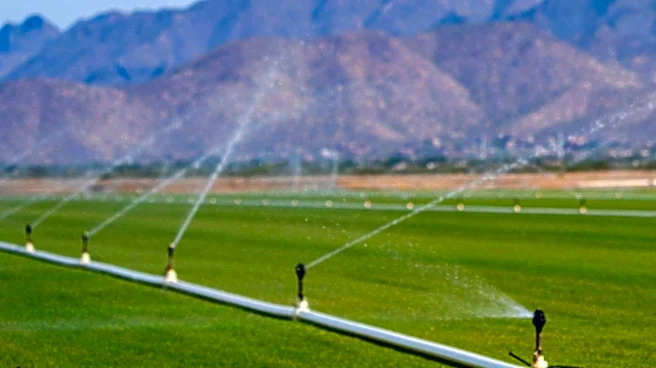
Farmers and ranchers in the Uintah Basin recently attended a demonstration by Utah State University's (USU) Extension Service showcasing new sprinkler technology designed to improve irrigation efficiency. The event, held at the Bar Lazy TL Ranch, featured
USU researchers, politicians, and reporters observing the sprinklers in an alfalfa field. Burdette Barker, an irrigation specialist with USU's Extension Service, noted that while wheel line systems have existed for decades, significant improvements have been lacking. The new sprinklers feature a different spray pattern and incorporate automation to modernize existing wheel line systems. Researchers gathered feedback from farmers, who often move their irrigation lines manually at various times of the day. One farmer, Kolby Hullinger, acknowledged the advantages of the new options despite some practical concerns about a specific valve. This initiative is part of a broader effort to address Utah's water usage, as agriculture is the state's largest water consumer, amidst concerns over the shrinking Great Salt Lake and the Colorado River crisis.
Why It's Important?
This USU experiment holds significant importance for Utah's agricultural sector and the state's broader water conservation efforts. With agriculture being the primary water user in Utah, and the Great Salt Lake facing critical shrinkage alongside the Colorado River system's crisis, finding ways to reduce water consumption in farming is paramount. The development of more efficient and automated sprinkler systems could lead to substantial water savings, directly impacting the sustainability of Utah's water resources. Furthermore, by potentially reducing the labor required for irrigation, these innovations could also improve the economic viability of farms and ranches, offering a dual benefit of environmental stewardship and agricultural support. The state has already invested millions in incentives and programs to encourage water-saving practices among farmers, making research like USU's crucial for developing practical solutions that can be adopted statewide. The preliminary findings suggest potential cost savings for farmers, which could incentivize wider adoption of these new technologies.
What's Next?
USU's Extension Service plans to continue gathering data on the new sprinkler systems to confirm their water-saving capabilities. While preliminary information indicates potential cost savings, further research is needed to definitively quantify water conservation. The ultimate goal is to enable farmers to tailor their water use more precisely, potentially through automated scheduling from remote locations, rather than requiring manual adjustments in the field. In parallel, USU's Extension Service operates the AG-DRIP program, funded by $5 million from the Central Utah Water Conservancy District and the Colorado River Authority of Utah. This program actively recruits farmers and ranchers to participate in identifying water savings on their properties. The ongoing research and the AG-DRIP program suggest a continued push towards developing and implementing water-efficient agricultural practices across Utah, with future efforts likely focusing on refining the technology and expanding farmer participation in conservation initiatives.
Beyond the Headlines
The USU sprinkler experiment transcends immediate agricultural benefits, touching upon critical long-term environmental and economic implications for Utah. The state's reliance on agriculture, coupled with escalating water scarcity issues, positions this research as a vital component of regional climate adaptation strategies. Beyond the direct water savings, the automation aspect of the new systems could contribute to a broader modernization of agricultural practices, potentially attracting a new generation of farmers and enhancing food security through more resilient farming methods. The collaboration between USU, farmers, and state agencies like the Central Utah Water Conservancy District and the Colorado River Authority of Utah highlights a proactive, multi-stakeholder approach to resource management. This model could serve as a blueprint for other regions facing similar environmental challenges, demonstrating how technological innovation, scientific research, and policy support can converge to address complex issues like water conservation in arid and semi-arid lands. The ethical dimension of resource allocation, particularly between urban and agricultural demands, is also implicitly addressed by solutions that aim to optimize existing agricultural water use.