
What's Happening?
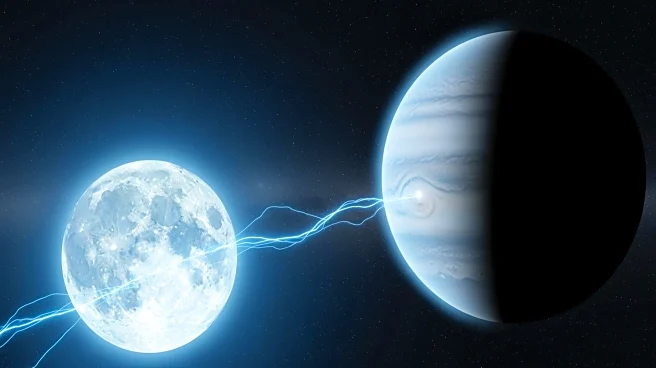
A study using data from the Cassini spacecraft has revealed that Saturn's moon Enceladus exerts a significant electromagnetic influence on the planet. Researchers discovered a lattice-like structure of
reflected waves, known as 'Alfvén wings,' that extend from Enceladus to Saturn's poles. These waves travel along magnetic field lines, demonstrating Enceladus' role in circulating energy and momentum around Saturn's space environment. The study, published in the Journal of Geophysical Research: Space Physics, highlights how Enceladus acts as a planetary-scale Alfvén wave generator, influencing Saturn over vast distances.
Why It's Important?
This discovery enhances our understanding of the complex interactions between Saturn and its moons, particularly Enceladus. The findings suggest that small celestial bodies with electrically conducting atmospheres can have significant impacts on their host planets. This knowledge could inform future studies of other planetary systems, including the icy moons of Jupiter and exoplanets. Understanding these interactions is crucial for developing accurate models of planetary magnetospheres and could influence future space missions aimed at exploring these environments.
What's Next?
The study sets the stage for future missions to Enceladus, such as the planned ESA orbiter and lander in the 2040s, which aim to study these electromagnetic interactions in greater detail. Continued research may reveal more about the moon's influence on Saturn and its potential implications for other planetary systems. As scientists gather more data, they may uncover additional insights into the dynamics of Saturn's magnetosphere and the role of its moons in shaping it.