






What's Happening?
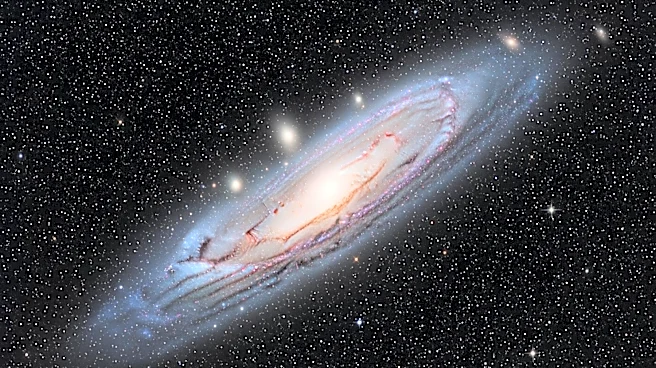
Astronomers using the James Webb Space Telescope have identified a massive galaxy, XMM-VID1-2075, that does not exhibit the expected rotational motion. This discovery is surprising because the galaxy formed when the universe was less than 2 billion years
old, a period when galaxies are typically expected to spin due to the angular momentum generated by gas inflow and gravitational forces. The research, led by Ben Forrest from the University of California, Davis, and published in Nature Astronomy, highlights that this galaxy's lack of rotation is unusual for its age and size. The team, part of the MAGAZ3NE survey, had previously confirmed the galaxy's mass and lack of new star formation using the W.M. Keck Observatory. The Webb Telescope's observations revealed that while one of the three studied galaxies rotates and another shows irregular structure, XMM-VID1-2075 displays strong random motion of its stars without rotation.
Why It's Important?
This finding challenges existing models of galaxy formation and evolution, which suggest that galaxies should spin as they form. The presence of a non-spinning galaxy so early in the universe's history could indicate that current theories need revision. Understanding why this galaxy does not rotate could provide insights into the processes that influence galaxy dynamics, such as mergers or collisions. If such non-rotating galaxies are more common than previously thought, it could significantly impact our understanding of cosmic evolution and the forces shaping galaxies. This research also demonstrates the capabilities of the James Webb Space Telescope in studying distant galaxies, offering a new perspective on the early universe.
What's Next?
Researchers are continuing to search for similar non-rotating galaxies in the early universe to test the validity of current galaxy formation theories. By comparing observational data with computer simulations, scientists aim to determine the frequency of such galaxies and refine models of cosmic evolution. The team is particularly interested in understanding whether a single dramatic collision or other factors could explain the lack of rotation in XMM-VID1-2075. Further studies could provide crucial data to adjust theoretical frameworks and enhance our comprehension of galaxy dynamics.