
What's Happening?
An experiment on the International Space Station (ISS) has demonstrated that microbes can extract metals from meteorite fragments in microgravity. Conducted by researchers from Cornell University and the University of Edinburgh, the BioAsteroid experiment involved
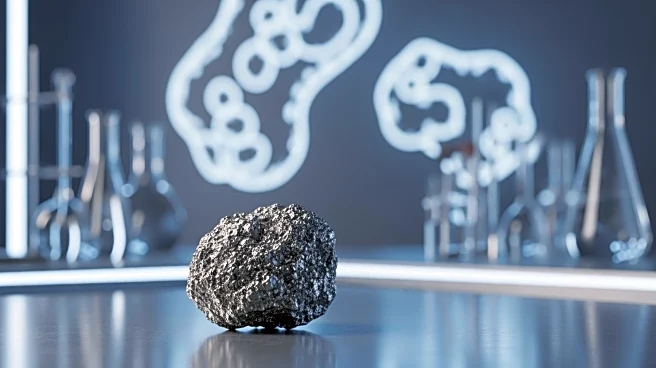
placing bacteria and fungi on a meteorite to study their ability to leach metals. Over 19 days, the microbes successfully extracted 18 elements, including valuable metals like palladium and platinum. This experiment suggests that biological processes could play a crucial role in future space missions by enabling the extraction of resources from asteroids and other celestial bodies.
Why It's Important?
The ability to extract metals from meteorites using microbes has significant implications for space exploration and the development of self-sufficient space habitats. As missions venture further from Earth, relying on local resources becomes essential. Biomining, which uses microorganisms to leach metals, offers a sustainable and efficient alternative to traditional mechanical extraction methods. This approach could support the construction of infrastructure, manufacturing, and life support systems on the Moon, Mars, and beyond, reducing the need for costly resupply missions from Earth.
What's Next?
The success of the BioAsteroid experiment opens the door for further research into biomining in space. Future studies will explore the potential of using microbes to extract other valuable resources and support life support systems by releasing nutrients from regolith. The findings also encourage the development of technologies to integrate biomining into space missions, potentially leading to the establishment of permanent human settlements on other planets. As researchers continue to refine these techniques, the role of biology in space exploration is likely to expand, offering new possibilities for sustainable space travel.