









What's Happening?
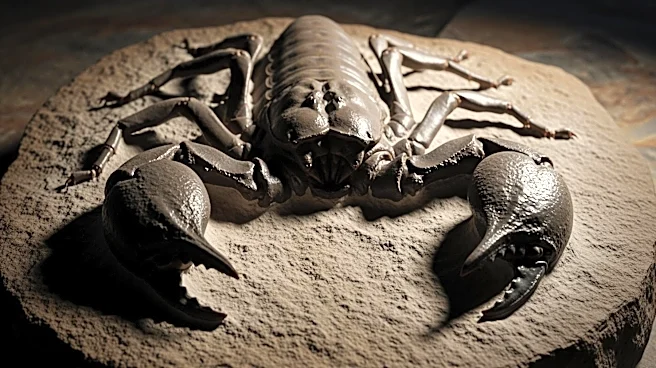
Scientists have confirmed that fossil fragments discovered in the United Kingdom belonged to Praearcturus gigas, a prehistoric scorpion that lived approximately 415 million years ago. This species is believed to have measured more than three feet long,
making it the largest scorpion ever identified. The discovery was highlighted by London's Natural History Museum and published in the journal Palaeontology. The fossils, known for over a century, were initially thought to belong to a giant crustacean. However, recent analysis led by Dr. Richie Howard, Curator of Fossil Arthropods at the Natural History Museum, confirmed its identity as a scorpion. This finding is significant due to the period it lived in, the Early Devonian Period, when life on land was still emerging.
Why It's Important?
The confirmation of Praearcturus gigas as a giant scorpion provides new insights into the evolution of arthropods and the ecological dynamics of the Early Devonian Period. This period was crucial for the development of life on land, and the presence of such a large predator suggests a unique ecological niche with little competition. Understanding these ancient ecosystems can help scientists learn more about the evolutionary pressures that shaped modern biodiversity. The discovery also highlights the importance of re-evaluating historical fossil records with modern techniques, which can lead to new interpretations and insights into prehistoric life.