
What's Happening?
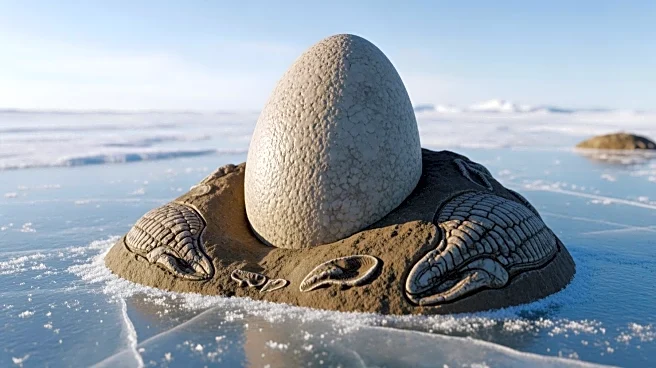
A 68-million-year-old fossil egg, nicknamed 'The Thing,' has been unearthed in Antarctica, providing new insights into the reproductive strategies of ancient marine reptiles. The egg, measuring approximately
11 inches long and 8 inches wide, is the largest soft-shelled egg ever discovered and the second largest egg from any animal. Initially, the fossil did not resemble an egg, appearing more like a deflated bag. However, microscopic examination revealed a delicate wall similar to modern lizard or snake eggs. This discovery challenges previous assumptions that large marine reptiles, such as mosasaurs, gave birth to live young. Instead, the thin, flexible shell suggests that these reptiles laid soft-shelled eggs in water, with the young hatching almost immediately. The egg was found near bones of Kaikaifilu hervei, a large mosasaur species, suggesting a possible link between the two.
Why It's Important?
This discovery is significant as it alters the understanding of reproductive strategies among ancient marine reptiles. Previously, it was believed that these creatures primarily gave birth to live young, a trait known as viviparity. The finding of a soft-shelled egg suggests a mixed reproductive strategy, where eggs were laid in water and hatched quickly. This could indicate a broader range of reproductive adaptations among marine reptiles than previously thought. The preservation of such a delicate fossil also highlights the unique sedimentary conditions of ancient Antarctica, which allowed for the survival of soft-shelled eggs. This contributes to the broader understanding of how life adapted to the polar environments of the past.
What's Next?
Further research is likely to focus on confirming the link between the egg and Kaikaifilu hervei, as well as exploring other potential reproductive strategies among marine reptiles. Paleontologists may also investigate similar sedimentary environments for additional soft-shelled eggs, which could provide more comprehensive insights into the evolution of reptile reproduction. The study of these fossils could also inform current understanding of how climate and environmental conditions influence reproductive strategies in marine life.
Beyond the Headlines
The discovery of this fossil egg not only provides insights into ancient reproductive strategies but also raises questions about the evolutionary pressures that led to the development of soft-shelled eggs. The presence of such eggs in polar regions suggests that these reptiles had adapted to cold, seasonal environments, which could have implications for understanding how modern reptiles might adapt to changing climates. Additionally, the preservation of the egg in Antarctic sediments underscores the importance of these regions in paleontological research, offering a window into the past ecosystems and the life forms that inhabited them.