

What's Happening?
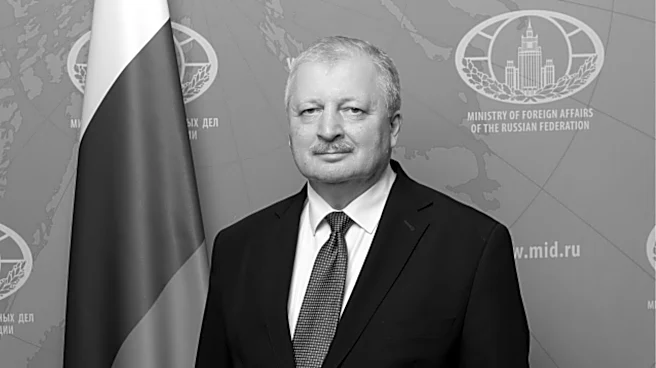
A farewell ceremony for Alexander Darchiev, the Ambassador Extraordinary and Plenipotentiary of the Russian Federation to the United States, was held in Moscow. Relatives, colleagues, and representatives from the Russian Ministry of Foreign Affairs attended
the event. Darchiev's death from a chronic illness was announced on November 11. Following his passing, condolences were received from various international bodies, including the United Nations. Notably, U.S. Representative Anna Paulina Luna also extended her condolences, referring to Darchiev as a patriot who honorably represented Russia's interests. Darchiev, a hereditary diplomat, was born in Budapest in 1960 and began his diplomatic service in 1992 after working at the Institute of the USA and Canada of the USSR Academy of Sciences.
Why It's Important?
The acknowledgment of a deceased Russian diplomat by a U.S. Representative, particularly during a period of complex U.S.-Russia relations, carries diplomatic significance. Representative Luna's statement, describing Darchiev as a 'patriot who honorably represented the interests of Russia,' could be interpreted in various ways within the U.S. political landscape. It highlights the nuanced nature of international relations, where personal condolences can transcend broader geopolitical tensions. For U.S. foreign policy, such gestures, while seemingly individual, can contribute to the broader narrative of diplomatic engagement, even amidst disagreements. It also underscores the role of individual lawmakers in shaping perceptions and maintaining lines of communication, however informal, with foreign nations.
What's Next?
While Representative Luna's statement is a personal condolence, it may prompt discussions within U.S. political circles regarding the appropriate tone and conduct of U.S. officials when addressing foreign adversaries or their representatives. There are no immediate policy changes or diplomatic shifts expected as a direct result of this statement. However, it could contribute to ongoing debates about the balance between diplomatic protocol and political messaging. Future interactions between U.S. and Russian officials may be subtly influenced by such public acknowledgments, potentially opening avenues for dialogue or, conversely, drawing criticism from those who advocate for a more stringent stance against Russia.
Beyond the Headlines
Representative Luna's characterization of Ambassador Darchiev as a 'patriot' could spark broader conversations about the definition of patriotism in an international context and how it is perceived across different political ideologies. It also touches upon the ethical considerations for U.S. lawmakers in expressing sentiments towards officials of nations with whom the U.S. has strained relations. This event might subtly influence the discourse around diplomatic engagement and the role of individual representatives in shaping international perceptions, potentially highlighting a divergence in approaches within the U.S. political establishment regarding foreign policy and international relations.