







What's Happening?
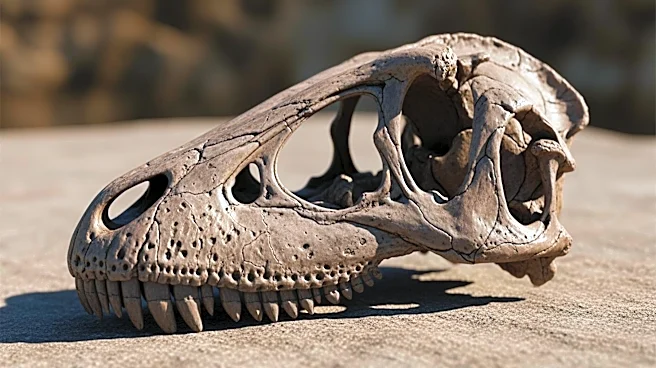
Recent research led by Christopher Griffin of Princeton University has provided strong evidence that Nanotyrannus, previously thought to be a juvenile Tyrannosaurus rex, is a distinct species. The study focused on the original Nanotyrannus fossil, a skull
housed at the Cleveland Museum of Natural History. Researchers examined the ceratobranchial, or hyoid bone, using bone histology to determine the age of the specimen. The analysis revealed growth patterns indicating that the animal had reached or was close to full maturity, suggesting it was not a young T. rex. This finding supports the classification of Nanotyrannus as a separate species, distinct from the larger T. rex. The research, published in Science, challenges the long-standing assumption that Nanotyrannus was merely a juvenile T. rex.
Why It's Important?
The confirmation of Nanotyrannus as a distinct species has significant implications for understanding dinosaur ecosystems. If both Nanotyrannus and T. rex coexisted, it suggests that multiple large predators shared the same environment, which could reshape our understanding of prehistoric ecological dynamics. This discovery also highlights the potential for new methods in paleontology, as the study utilized the hyoid bone, a less commonly analyzed bone, to determine maturity. This approach could open new avenues for studying fragmentary remains and provide deeper insights into the life histories of extinct species. The findings contribute to the broader understanding of dinosaur biodiversity and evolution.
What's Next?
The resolution of the Nanotyrannus debate may lead to further investigations into the ecological roles of different dinosaur species. Researchers may explore how these predators interacted within their ecosystems and what factors contributed to their coexistence. Additionally, the study's methodology could inspire similar analyses of other dinosaur fossils, potentially leading to the reclassification of other species. As paleontologists continue to uncover and analyze fossils, new questions about dinosaur behavior, adaptation, and extinction may arise, offering a more comprehensive picture of the prehistoric world.
Beyond the Headlines
The study's use of the hyoid bone as a reliable indicator of age challenges traditional paleontological methods, which often rely on larger bones like ribs or femurs. This innovation could lead to a reevaluation of existing fossil collections and prompt new discoveries about dinosaur growth and development. Furthermore, understanding the diversity of dinosaur species and their ecological niches can provide insights into the factors that led to their extinction, offering lessons for modern conservation efforts and the management of current ecosystems.