




What's Happening?
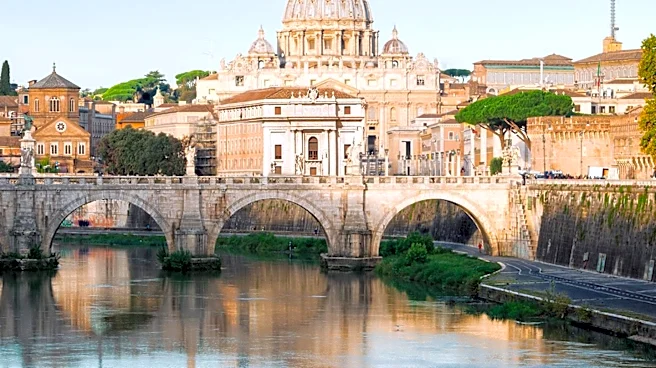
Vatican City, a sovereign enclave within Rome, was formally established on February 11, 1929, through the signing of the Lateran Treaty. This agreement, signed by Cardinal Secretary of State Pietro Gasparri and Prime Minister Benito Mussolini, recognized
the Holy See as a subject of international law and provided financial compensation for the previously lost Papal States. Covering approximately 0.49 square kilometers, Vatican City remained neutral during World War II. Since 1945, it has evolved into a globally connected center for Catholic governance, expanding its diplomatic network and achieving permanent observer status at the United Nations in 1964. Historically, the area now known as Vatican City, specifically the Mons Vaticanus, was outside ancient Rome and contained gardens, a circus, and burial grounds. Christian tradition holds that the apostle Peter was martyred and buried in the adjacent necropolis, leading to the construction of a basilica over his supposed tomb in 326 by Emperor Constantine, which solidified the Vatican's role as a Christian hub.
Why It's Important?
The establishment of Vatican City as an independent state through the Lateran Treaty was a pivotal moment, resolving the 'Roman Question' that had persisted since the unification of Italy extinguished the Papal States in 1870. This resolution granted the Holy See political autonomy, allowing it to operate as a sovereign entity on the international stage. This status is crucial for the Catholic Church's global diplomatic efforts and its ability to influence international affairs, humanitarian causes, and interfaith dialogue. The Vatican's neutrality during World War II, facilitated by its sovereign status, underscored its unique position in global politics. Its subsequent role as a permanent observer at the United Nations further cemented its influence, enabling it to advocate for peace, human rights, and social justice from a distinct moral and spiritual perspective. For the United States, the Vatican's diplomatic presence and moral authority contribute to global stability and provide a unique channel for addressing complex international issues, particularly those involving religious freedom and humanitarian concerns.
What's Next?
As a sovereign state, Vatican City will continue to engage in international diplomacy and maintain its role as the spiritual and administrative center of the Roman Catholic Church. Its ongoing participation as a permanent observer at the United Nations suggests continued involvement in global discussions on peace, human rights, and social development. The Vatican's diplomatic network is likely to further expand, allowing it to address contemporary global challenges such as climate change, poverty, and interreligious conflict. Internally, Vatican City operates as an absolute elective monarchy under the sovereignty of the reigning Pope, who exercises legislative, executive, and judicial authority. This structure ensures continuity in its governance and its mission. For individuals, such as China passport holders, the requirement of a visa for entry, with a stay limit of up to 30 days and a standard processing time of 7-14 business days, indicates the ongoing enforcement of its sovereign borders and immigration policies.
Beyond the Headlines
The historical evolution of Vatican City, from ancient Roman burial grounds to a global spiritual and political center, highlights the enduring power of religious belief and institutional resilience. The Vatican Necropolis beneath St. Peter's Basilica offers a tangible link to its ancient past, illustrating how religious sites can become focal points for cultural and political development. The Lateran Treaty not only resolved a long-standing territorial dispute but also established a unique model of statehood, where spiritual authority is intertwined with political sovereignty. This model raises profound questions about the separation of church and state, the role of religion in international relations, and the nature of sovereignty itself. The Vatican's continued emphasis on moral and ethical issues, such as its recent warnings about artificial intelligence, demonstrates its commitment to guiding humanity through complex modern challenges, often from a perspective that transcends national interests and focuses on universal human dignity.