
What's Happening?
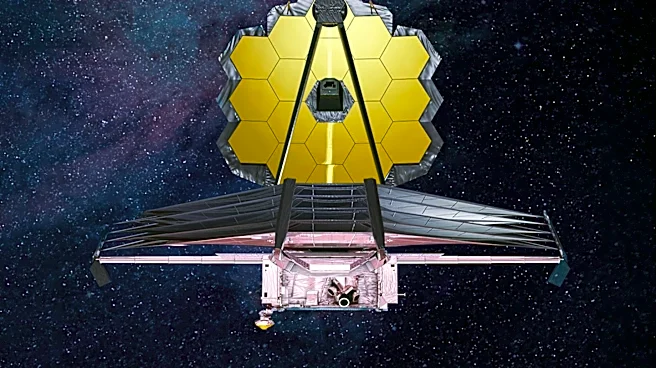
NASA has taken a significant step forward in its contributions to the Laser Interferometer Space Antenna (LISA) mission by developing a new all-glass Engineering Test Unit telescope. This telescope is a crucial component for the space observatory, which
is designed to detect gravitational waves, ripples in space-time predicted by Albert Einstein. The LISA mission, led by the European Space Agency (ESA) and slated for launch in the mid-2030s, will deploy three satellites in an Earth-following orbit, forming a triangular array with sides stretching 1.6 million miles. Each satellite will house two telescopes that transmit and receive infrared laser beams to precisely measure minuscule changes in their relative distances, indicating the presence of gravitational waves. L3Harris Technologies is responsible for designing, assembling, and integrating this new telescope for NASA, marking a final developmental step before the production of flight hardware. The telescope is constructed entirely from Zerodur, an amber-colored ceramic-glass composite known for its stability across varying temperatures.
Why It's Important?
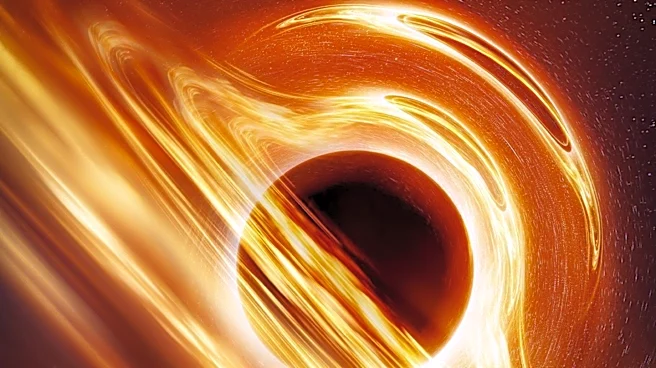
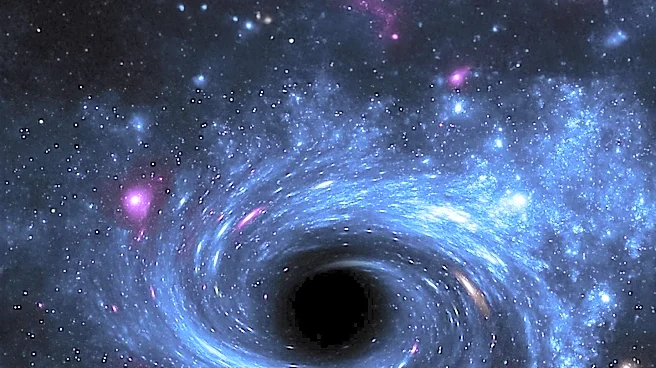
NASA's advancement in developing the LISA mission telescope is vital for the future of gravitational wave astronomy. Ground-based observatories have successfully detected gravitational waves from high-frequency events, but LISA will open a new window into the universe by detecting low-frequency gravitational waves. These waves originate from phenomena such as the mergers of supermassive black holes billions of light-years away, compact binary systems within our own galaxy, and potentially provide new insights into the fundamental nature of gravity. The precision required for these measurements, detecting changes smaller than the width of a helium atom over millions of miles, highlights the technological sophistication of this mission. NASA's contribution of critical hardware, engineering, and scientific support is essential for the mission's success, reinforcing international collaboration in cutting-edge space research and expanding humanity's understanding of cosmic evolution and fundamental physics.
What's Next?
The Engineering Test Unit telescope represents the last pre-flight unit and the first optical telescope delivery from NASA to ESA for the LISA mission. Following rigorous testing of a prototype delivered in 2024, lessons learned are being incorporated into this new unit. The successful development and testing of this all-glass telescope will pave the way for the production of the flight hardware needed for the three LISA spacecraft. As the mission progresses towards its mid-2030s launch, further integration and testing of all components, including the laser system and charge management devices, will be critical. Scientists and engineers will continue to refine data analysis techniques to effectively identify and characterize gravitational wave sources. The mission's success will depend on the seamless operation of these highly precise instruments across vast interstellar distances, promising a new era of astrophysical discoveries.
Beyond the Headlines
The LISA mission's pursuit of low-frequency gravitational waves delves into the universe's most extreme events, offering a unique perspective on cosmic history that electromagnetic radiation cannot provide. Gravitational waves are unaffected by intervening matter, allowing astronomers to observe phenomena hidden from traditional telescopes. This mission could reveal the formation and evolution of galaxies through the mergers of supermassive black holes, map the distribution of compact objects in the Milky Way, and even probe the very early universe, potentially shedding light on the Big Bang and the nature of dark energy. The technological innovations required for LISA, such as ultra-stable telescopes and highly precise laser interferometry over millions of kilometers, push the boundaries of engineering and metrology, with potential spin-off benefits for other scientific and industrial applications requiring extreme precision.