





What's Happening?
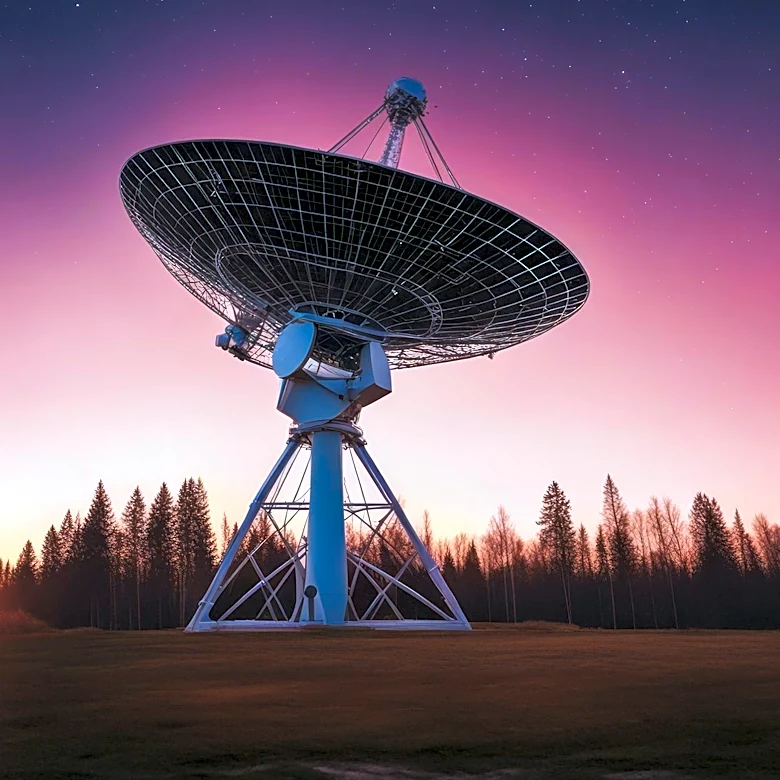
Astronomers have successfully detected the first-ever radio emission originating from an exoplanet, Beta Pictoris b, which is located approximately 63 light-years from Earth. This discovery was made using the MeerKAT array in South Africa. The radio signals
are attributed to processes within the planet's magnetic field, specifically auroras that are similar to Earth's northern lights. According to Edo Berger, a professor of astronomy at Harvard University and a coauthor of the paper, the detection of these radio waves at the observed frequencies indicates an incredibly strong magnetic field. Beta Pictoris b is a gas giant, roughly 12 times the mass of Jupiter, and is part of a young star system estimated to be about 23 million years old. The research, which is awaiting publication in a peer-reviewed journal, emphasizes that these signals are not indicative of intelligent life but rather point to the presence of a powerful magnetic field. The team, including lead study author Kevin Ortiz Ceballos, a doctoral researcher at the Center for Astrophysics | Harvard & Smithsonian, was surprised by the strength of the signal, as previous assumptions suggested exoplanet magnetic fields would produce lower-frequency emissions.
Why It's Important?
This groundbreaking detection of radio emissions from an exoplanet holds significant importance for understanding planetary science beyond our solar system. The presence of a strong magnetic field, estimated to be at least 200 times stronger than Jupiter's, has crucial implications for the structure and atmospheric conditions of exoplanets. Magnetic fields act as natural shields, protecting planetary atmospheres from being stripped away by stellar winds, similar to how Earth's magnetic field safeguards its atmosphere. This discovery provides a new method for astronomers to study exoplanets, offering insights into their fundamental properties that are otherwise difficult to measure. If confirmed through peer review, this finding challenges previous assumptions about the strength of exoplanet magnetic fields and could lead to a re-evaluation of planetary formation and evolution models. Understanding these magnetic fields is also vital for assessing the potential habitability of exoplanets, as a robust magnetosphere is considered a key factor in supporting life.
What's Next?
The research paper detailing this discovery is currently awaiting publication in a peer-reviewed journal, and the peer review process is expected to be completed in the coming months. Scientists not involved in the research, such as Jonathan Nichols, a professor in planetary auroras at the University of Leicester, have expressed cautious enthusiasm, highlighting that if the discovery holds up, it would be a significant step forward in understanding exoplanet behavior. The research team has requested additional telescope time to conduct further observations of Beta Pictoris b. These future studies aim to unravel the mysteries behind the planet's exceptionally strong magnetic field and explore other puzzles within the Beta Pictoris system. Continued monitoring and analysis will be crucial for confirming the initial findings and expanding our knowledge of exoplanetary magnetospheres and their broader implications for astrophysics.
Beyond the Headlines
The detection of auroral radio emissions from Beta Pictoris b opens up a new avenue for exoplanet characterization, moving beyond traditional methods like transit photometry and radial velocity. This technique allows scientists to infer properties of exoplanets that are otherwise inaccessible, such as the strength and configuration of their magnetic fields. The finding challenges the 'perceived wisdom' in the field, suggesting that exoplanets can possess magnetic fields far more powerful than previously anticipated. This could lead to a paradigm shift in how scientists model and search for potentially habitable worlds. While Beta Pictoris b itself, being a gas giant, is not considered habitable, the ability to detect and characterize magnetic fields in exoplanets provides a critical tool for identifying rocky exoplanets that might have the necessary atmospheric protection to support liquid water and, consequently, life. This development underscores the continuous evolution of astronomical observation techniques and our understanding of the universe.