
What's Happening?
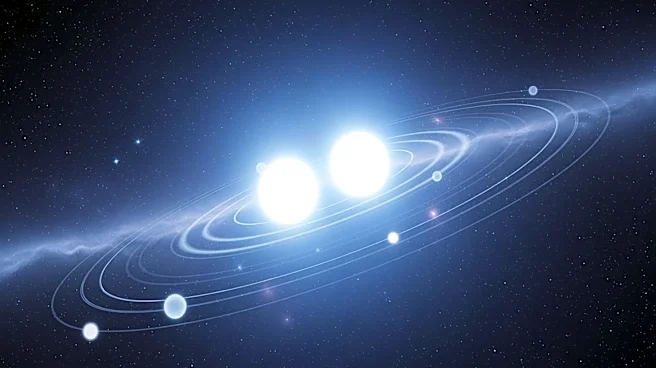
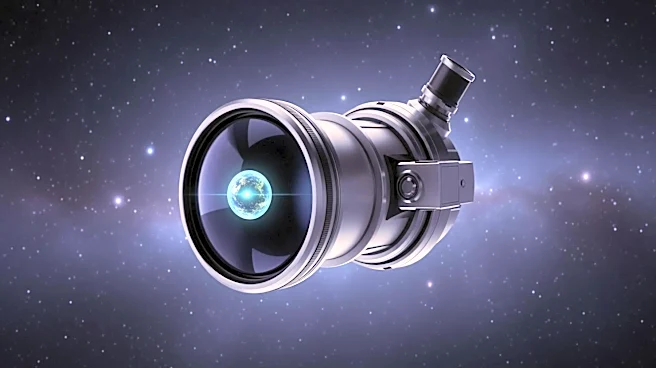
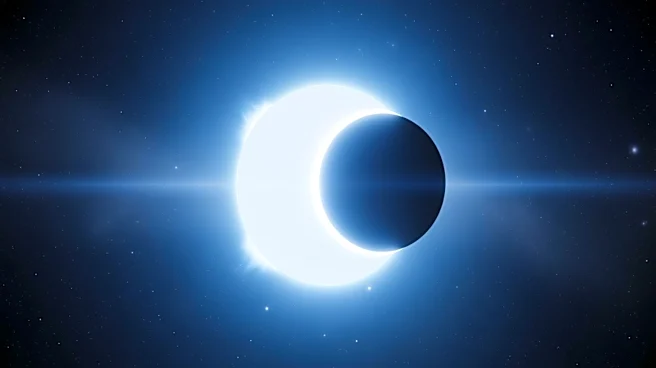
NASA's Transiting Exoplanet Survey Satellite (TESS) has identified over two dozen candidate exoplanets by analyzing data on stellar pairs undergoing mutual eclipses. This method allows TESS to locate planets that
might otherwise go undetected. TESS has already discovered 885 confirmed exoplanets and identified more than 7,900 candidates. The mission observes transits, where planets pass in front of their stars, causing a dip in brightness. TESS also studies eclipsing binary stars, where two stars alternately eclipse each other. By measuring the timing of these eclipses, astronomers can detect the gravitational influence of exoplanets. The study, led by Margo Thornton from the University of New South Wales, has found 27 candidate planets in binary systems, awaiting confirmation. The findings were published in the Monthly Notices of the Royal Astronomical Society.
Why It's Important?
The discovery of new exoplanet candidates in binary star systems expands our understanding of planetary formation and the diversity of planetary systems. This research could provide insights into how planets form and evolve in complex gravitational environments. The ability to detect planets in binary systems, which are common in the galaxy, increases the potential for finding habitable worlds. The TESS mission's ongoing data collection continues to be a valuable resource for astronomical discoveries, contributing to our knowledge of the universe and potentially identifying new targets for future exploration.
What's Next?
Confirming the candidate planets will require further ground-based observations to measure the velocities of the host stars, revealing the gravitational tugs of any planets. This process will help determine the masses of the candidates, which range from 12 Earth masses to about 10 times Jupiter's mass. The continued analysis of TESS data will likely lead to more discoveries, enhancing our understanding of planetary systems and informing future missions aimed at exploring these distant worlds.