
What's Happening?
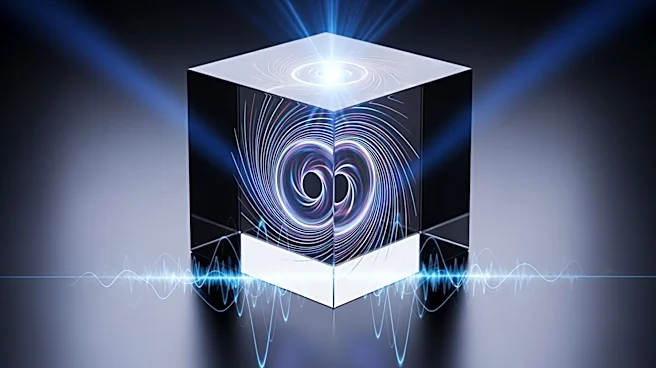
Researchers have developed a new method for optical encryption using biphasic chiral photonic crystals. This approach leverages the unique properties of light for high-dimensional parallel processing,
offering resistance to algorithmic attacks that threaten conventional electronic encryption. The biphasic chiral photonic crystals utilize distinct band gaps and photopatterned alignments to control wavelength and shape, enabling multichannel optical encryption. This technology is designed to enhance information security in sectors such as secure logistics and anti-counterfeiting. The crystals' ability to encode information across multiple physical channels, including circular polarization and temperature, establishes a foundation for high-capacity optical encryption.
Why It's Important?
As quantum computing advances, conventional encryption methods face increasing threats due to enhanced computational power. Optical encryption provides a robust alternative by utilizing physical-layer security strategies that are inherently resistant to such threats. The development of biphasic chiral photonic crystals represents a significant step forward in information security, offering potential applications in privacy-preserving displays and secure communications. This technology could play a crucial role in protecting sensitive data across various industries, ensuring that information remains secure despite advancements in computing power.
What's Next?
The continued development and refinement of optical encryption technologies are expected to address growing concerns about information security in the digital era. Researchers will likely focus on improving the scalability and cost-effectiveness of these solutions to meet the demands of emerging markets. As optical encryption becomes more prevalent, industries such as logistics and anti-counterfeiting may adopt these technologies to safeguard their operations. The integration of optical encryption into existing security frameworks could enhance overall data protection, providing a critical layer of defense against potential cyber threats.