



What's Happening?
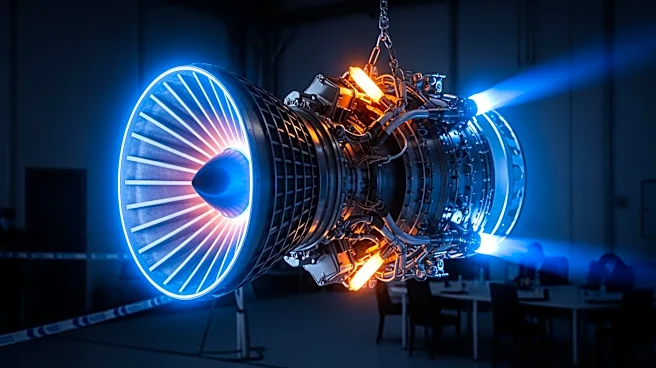
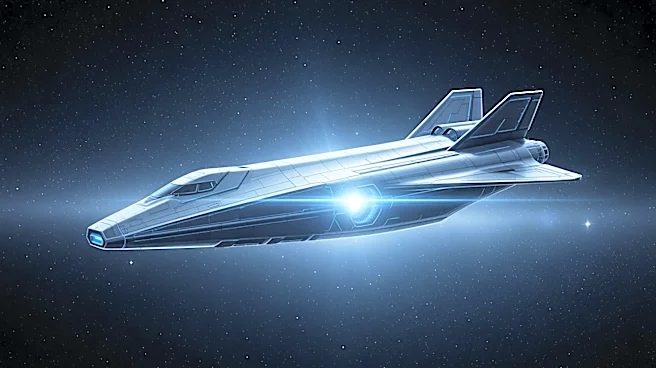
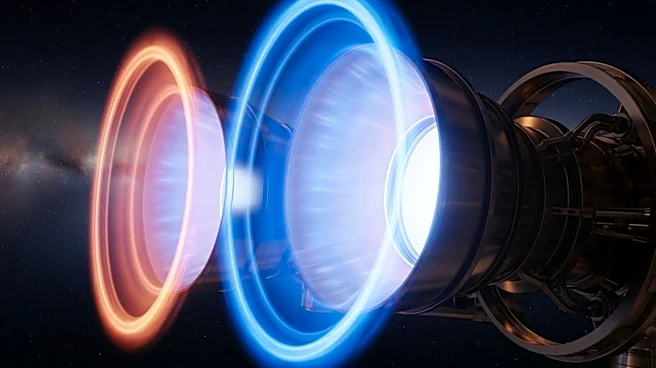
NASA has successfully tested a lithium-fed magnetoplasmadynamic (MPD) thruster at the Jet Propulsion Laboratory (JPL) in Southern California. This test marks a significant advancement in electric propulsion technology, achieving power levels of 120 kilowatts,
which surpasses any current electric propulsion system on U.S. spacecraft. The thruster uses lithium vapor, electromagnetically accelerated into plasma, to generate thrust. This development is part of NASA's long-term strategy for human missions to Mars, aiming to reduce travel time and launch mass requirements. The test is a result of over two years of development under NASA's Space Nuclear Propulsion program, in collaboration with Princeton University and NASA's Glenn Research Center.
Why It's Important?
The successful test of the lithium plasma engine represents a potential breakthrough in space travel, particularly for crewed missions to Mars. By offering stronger thrust and improved propellant efficiency, this technology could significantly reduce travel time and allow spacecraft to carry heavier payloads and larger crews. This advancement is crucial for NASA's goal of sending humans to Mars, as it addresses the challenges of long-duration space travel and the need for efficient propulsion systems. The development of such technology also positions the U.S. as a leader in space exploration, potentially influencing international space policy and collaboration.
What's Next?
NASA plans to scale the MPD thruster system to between 500 kilowatts and 1 megawatt per thruster, which is necessary for deep space applications. This involves addressing engineering challenges related to material endurance and thermal management. The agency will continue to conduct experiments to ensure the technology's operational readiness, focusing on durability under extreme conditions. These efforts are part of a broader strategy to integrate propulsion development with advancements in nuclear power generation, aiming to enable human missions to Mars within the coming decades.