




What's Happening?
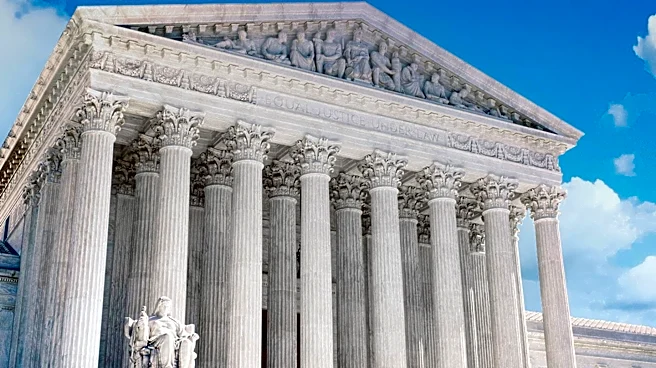
Justice Elena Kagan has consistently joined the liberal wing of the U.S. Supreme Court in dissenting against decisions that she believes undermine political independence and free speech, particularly concerning campaign finance. In a recent 6-3 decision,
the Court struck down federal limits on how much a political party can spend in coordination with its candidates. Justice Kagan, in her dissent, argued that this ruling effectively turns a political party into a candidate's checking account, allowing large sums of money to reach candidates indirectly, bypassing legal donation limits. She contends that the Court's current majority has narrowed the legal definition of corruption to only include explicit quid pro quo bribery, ignoring other forms of undue influence. This redefinition, according to Kagan, allows for a 'bribe with an extra step' where donors can route significant funds through parties to benefit specific candidates, thereby eroding the principle of political independence. The Court's majority, led by Justice Brett Kavanaugh, acknowledged the circumvention but concluded that existing disclosure rules adequately address it, based on their narrow definition of corruption.
Why It's Important?
This Supreme Court decision has significant implications for U.S. campaign finance and the integrity of the electoral process. By striking down limits on coordinated spending between political parties and candidates, the ruling effectively allows wealthy donors to exert greater influence over elections. While direct contributions to candidates remain capped, the new interpretation permits unlimited funds to flow through political parties to support specific campaigns, potentially creating a system where financial access dictates political outcomes. This shift could diminish the influence of individual voters, whose power is primarily through their vote, by making candidates more beholden to large donors. The decision could lead to increased spending in elections, further escalating the cost of campaigns and potentially making it harder for candidates without access to significant financial backing to compete. It also raises questions about the transparency and accountability of political funding, as money can now take a 'scenic route' to candidates, making it more challenging to track the true sources of campaign support.
What's Next?
In the immediate future, both political parties are expected to utilize the new latitude provided by this Supreme Court ruling, leading to potentially increased coordinated spending in upcoming elections, including the midterms. This could result in a significant influx of money into campaigns, with parties acting as conduits for larger donor contributions. The decision is likely to fuel ongoing debates about campaign finance reform and the role of money in politics. While an ordinary statute cannot override the Court's reading of the First Amendment, the only tool strong enough to address this issue would be a constitutional amendment. Such an amendment would aim to affirm the government's ability to regulate money in politics to prevent not just bribery but also the corrosion of political independence. However, achieving a constitutional amendment is a lengthy and challenging process, requiring broad political consensus. Therefore, the current framework, as defined by the Court, is likely to remain in place for the foreseeable future, with its implications unfolding in subsequent election cycles.
Beyond the Headlines
The Supreme Court's narrow definition of corruption, as highlighted by Justice Kagan, delves into a fundamental philosophical debate about the nature of political influence and the health of a democratic system. The Court's majority believes that only explicit quid pro quo bribery constitutes corruption, viewing other forms of financial influence as protected free speech. However, critics, including Justice Kagan, argue that this perspective overlooks the more subtle yet pervasive forms of corruption, where systematic financial dependence on a narrow set of funders can subtly bend the judgment of officeholders. This broader understanding of corruption, which some legal scholars argue was closer to the Framers' intent, recognizes that the danger is not just a direct exchange of cash for a vote, but the gradual erosion of political independence due to financial relationships. The long-term implication is a potential shift in whose concerns elected officials prioritize, moving away from the broader electorate towards those with significant financial resources. This could lead to a system where policy decisions are increasingly shaped by the interests of wealthy donors, rather than the needs of the general public, thereby impacting the perceived legitimacy and fairness of democratic governance.