





What's Happening?
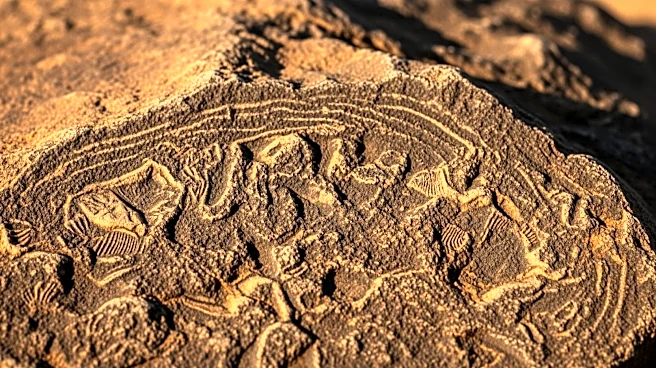
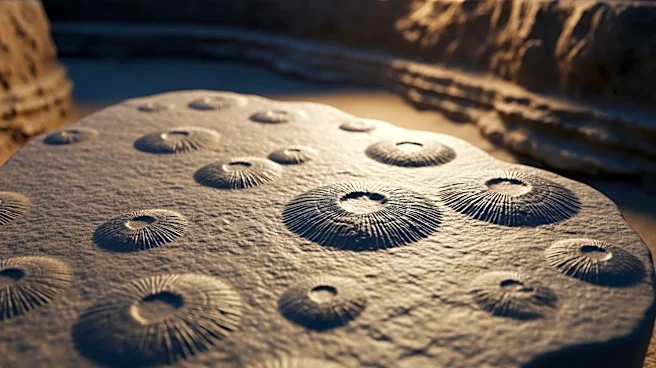
A new fossil site in southwest China, known as the Jiangchuan Biota, has been discovered, containing approximately 700 fossils that date back 539 to 554 million years. This discovery provides new insights into the transition between the Precambrian and
Phanerozoic eons. The fossils include previously unknown lifeforms and others that were thought to exist only in Cambrian rocks, suggesting that complex life may have originated earlier than previously believed. The presence of bilaterians, including deuterostomes, indicates that ancestors of modern vertebrates, including humans, existed during the Ediacaran period.
Why It's Important?
This discovery has significant implications for our understanding of the evolution of complex life on Earth. It challenges the traditional view of the Cambrian Explosion as the sole period of rapid diversification of life forms. By pushing back the timeline of complex life, the Jiangchuan Biota provides a more nuanced understanding of evolutionary history. This could lead to a reevaluation of the fossil record and the processes that led to the development of diverse life forms. The findings also highlight the importance of continued paleontological research in uncovering the mysteries of Earth's past.
What's Next?
Researchers will likely conduct further studies on the Jiangchuan Biota to better understand the conditions that led to the preservation of these fossils. This could involve detailed analysis of the fossilized organisms and their environments. The discovery may prompt a reexamination of other fossil sites to identify similar patterns of early complex life. Additionally, the findings could influence future research directions in evolutionary biology and paleontology, as scientists seek to fill gaps in the fossil record and refine the timeline of life's evolution on Earth.