
What's Happening?
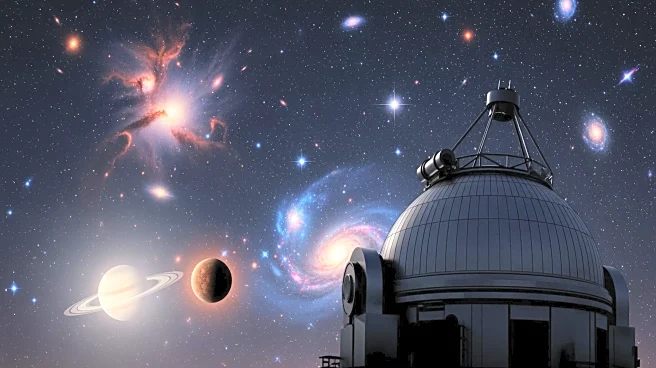
Astronomers using the Subaru Telescope in Hawai'i have identified two significant celestial objects: a giant planet and a brown dwarf, orbiting distant stars. These discoveries are the first successes
of the Observing Accelerators with SCExAO Imaging Survey (OASIS), which combines precise space-based data with Subaru's advanced imaging systems. The giant planet, HIP 54515 b, is located 271 light-years away in the constellation Leo and has nearly 18 times the mass of Jupiter. The brown dwarf, HIP 71618 B, is about 60 times the mass of Jupiter and is situated 169 light-years away in the constellation Bootes. These findings are crucial for NASA's upcoming Roman Space Telescope, which will test new tools designed to image Earth-like planets.
Why It's Important?
The discovery of these celestial bodies is significant for several reasons. It demonstrates the effectiveness of combining space-based data with ground-based imaging to uncover objects that are otherwise difficult to detect. This approach allows astronomers to pinpoint and photograph planets and brown dwarfs hidden by the brightness of their host stars. The findings also provide a valuable test target for NASA's Roman Space Telescope, which aims to advance the technology needed to image Earth-like planets. This could lead to breakthroughs in understanding planetary systems and the potential for life beyond Earth.
What's Next?
The discoveries set the stage for future astronomical research and technology demonstrations. The Roman Space Telescope will use HIP 71618 B as a test target for its advanced coronagraph systems, essential for future missions to image Earth-like planets. This will help refine techniques for observing faint celestial objects and improve our understanding of planetary formation and evolution. The success of OASIS suggests that the Subaru Telescope will continue to play a pivotal role in astronomical discoveries, even as new telescopes are developed.