





What's Happening?
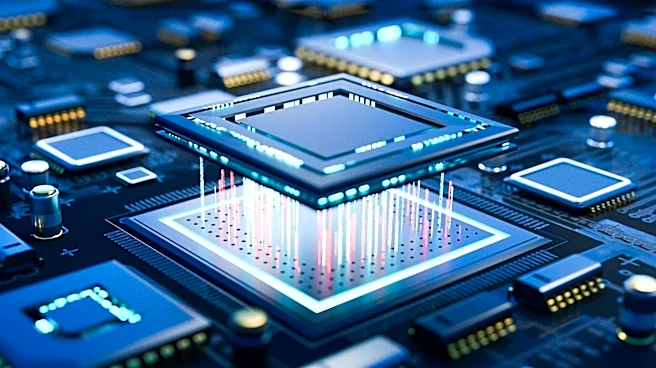
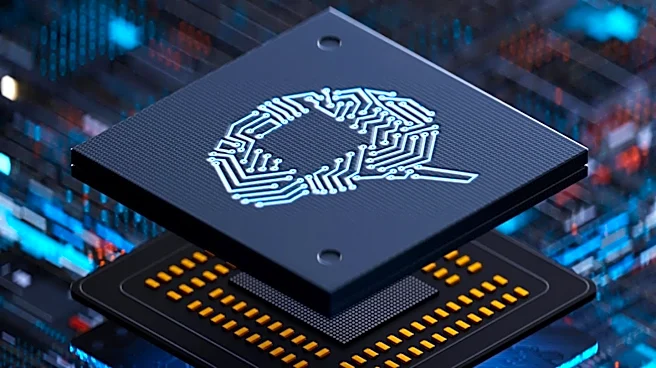
IBM has announced significant advancements with its Quantum Nighthawk processor, demonstrating new levels of speed and quality in quantum computing. The IBM Quantum Nighthawk r2 has achieved up to 19x speedups beyond previous IBM quantum processors, executing
up to 100,000 samples per second while maintaining accuracy with over 7,500 quantum operations on 120 qubits. This performance is attributed to high-speed qubit reset technology, which efficiently collects the millions or billions of samples required for complex computations. Building on this, IBM plans to introduce the Nighthawk r3 processor, designed to execute 10,000 quantum operations across 520 qubits, with a total of 2,034 physical qubits. By 2027, IBM intends to link two Nighthawk r3 processors into a single system exceeding 1,000 qubits, further scaling its high-performance architecture for larger and more complex computations. The company is also integrating high-performance classical and quantum computing into a single managed environment, allowing users to combine quantum workflows with classical resources, including supercomputers.
Why It's Important?
These advancements by IBM are crucial for the progression of quantum computing from theoretical potential to practical application. The increased speed and quality of the Nighthawk processors mean that industry-relevant workloads can be processed more efficiently and accurately, potentially accelerating breakthroughs in various fields. The integration of classical and quantum computing within a unified platform addresses a key challenge in scaling quantum workloads, which often require substantial classical resources for error correction and mitigation. This hybrid approach could enable more complex simulations and optimizations that are currently beyond the reach of classical supercomputers alone. The planned 1,000+ qubit system by 2027 signifies a major step towards achieving quantum advantage, where quantum computers can solve problems intractable for even the most powerful classical machines. This could have profound implications for industries such as energy, materials science, and machine learning, as demonstrated by E.ON's 15x speedup in quantum machine learning for energy grid optimization using Nighthawk r2.
What's Next?
IBM's immediate next step involves the development and deployment of the Nighthawk r3 processor, which will support 10,000 quantum operations on 520 programmable qubits. By 2027, the company plans to connect two Nighthawk r3 processors to create a single system with over 1,000 qubits. This scaling is expected to enable the tackling of even larger and more complex problems. IBM will continue to focus on integrating quantum and classical computing resources within its Quantum Platform, aiming to enhance error correction and mitigation techniques. The company is also collaborating with institutions like Oak Ridge National Laboratory and AMD to co-locate Nighthawk with high-performance computing systems, further advancing hybrid quantum-classical architectures. These developments are geared towards delivering a fault-tolerant quantum computer, with IBM Quantum Starling targeted for 2029, which would mark a significant milestone in the journey towards widespread practical quantum computing.
Beyond the Headlines
The rapid progress in quantum computing, as exemplified by IBM's Nighthawk series, hints at a future where computational capabilities could fundamentally transform scientific research and industrial processes. The pursuit of quantum advantage and fault-tolerant quantum computers raises ethical and societal questions regarding data security, the potential for new forms of artificial intelligence, and the economic implications of such powerful technology. The ability to solve problems currently deemed intractable could lead to revolutionary discoveries in medicine, materials science, and climate modeling, but also necessitates careful consideration of access, control, and potential misuse. The increasing investment and collaboration between private companies and government entities, such as the support from Japan's Ministry of Economy, Trade and Industry, underscore the global race for quantum supremacy and the strategic importance placed on this technology. This technological leap could redefine the boundaries of what is computable, ushering in an era of unprecedented innovation and complex challenges.