





What's Happening?
A recent fossil discovery in Ethiopia's Ledi Geraru site is reshaping the understanding of human evolution. Researchers from Arizona State University have uncovered evidence that Australopithecus and the earliest known members of Homo coexisted in the same
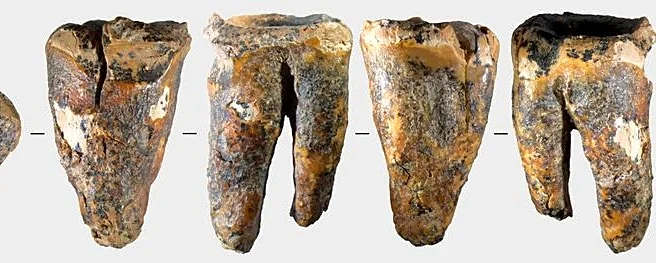
region between 2.6 and 2.8 million years ago. This finding challenges the traditional linear model of human evolution, suggesting a more complex scenario where multiple hominin species shared the landscape. The discovery includes 13 fossil teeth, which have provided critical insights into the evolutionary timeline. The research highlights that human evolution is not a straightforward progression but rather a 'bushy tree' with various species coexisting and some going extinct.
Why It's Important?
This discovery is significant as it alters the conventional narrative of human evolution, which often depicts a linear progression from ape-like ancestors to modern humans. The evidence of multiple hominin species coexisting suggests a more intricate evolutionary process with overlapping species. This complexity could lead to a reevaluation of how early human ancestors adapted to their environments and interacted with each other. The findings also emphasize the importance of continued fossil discoveries to fill gaps in the human evolutionary timeline. Understanding these dynamics is crucial for comprehending the evolutionary pressures that shaped modern humans.
What's Next?
The research team plans to continue excavations at the Ledi Geraru site to uncover more fossils that could provide further insights into the coexistence of different hominin species. There is a particular interest in identifying more fossil material to formally name the unidentified Australopithecus species and understand its place in the human family tree. Additionally, studies on tooth enamel are underway to determine the diets of these ancient species, which could reveal how they shared resources and habitats. These efforts aim to build a more comprehensive picture of early human evolution.
Beyond the Headlines
The discovery underscores the non-linear nature of evolution, challenging the simplistic view of a direct lineage from early hominins to modern humans. It highlights the role of environmental factors and ecological niches in shaping evolutionary paths. The findings also raise questions about the interactions between different hominin species, including potential competition or cooperation. This complexity adds depth to the study of human origins and may influence how future research is conducted in paleoanthropology.