
What's Happening?
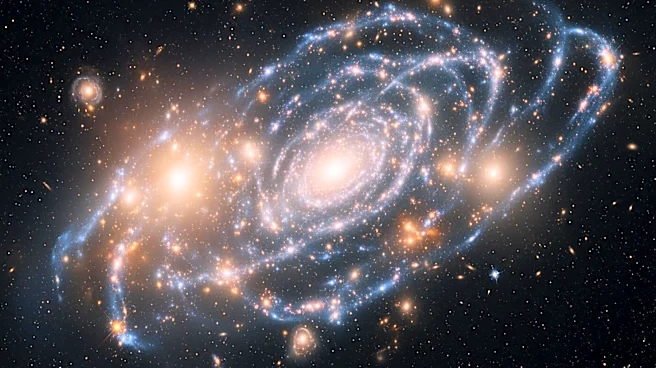
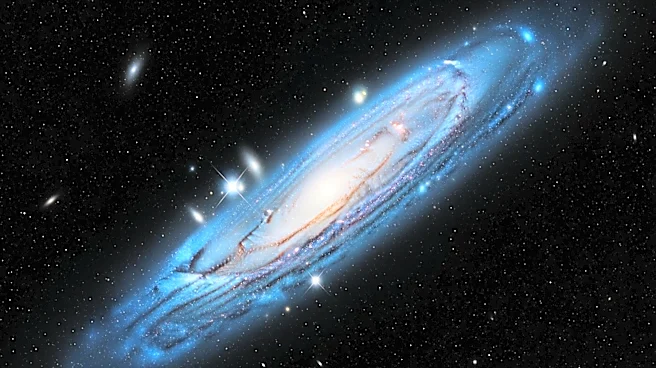
An international team of astronomers has identified the boundary of the Milky Way's star-forming disk, finding it closer than previously thought. The study reveals that most star formation occurs within
about 40,000 light-years of the Galactic Center. This conclusion was reached by analyzing the ages of bright giant stars and using advanced simulations of galaxy evolution, which showed a distinct 'U-shaped' pattern in stellar ages distribution.
Why It's Important?
This discovery provides a clearer understanding of the Milky Way's structure and star formation processes. By pinpointing the star-forming boundary, astronomers can better understand the dynamics of our galaxy and the factors influencing star formation. This knowledge is crucial for the field of galactic archaeology, as it helps scientists decode the history and evolution of the Milky Way, offering insights into the broader mechanisms of galaxy formation and development.
What's Next?
Future surveys such as 4MOST and WEAVE are expected to provide more detailed observations, allowing astronomers to refine these measurements and further explore the factors shaping the Milky Way's structure. These advancements will enhance our understanding of galactic dynamics and the processes that govern star formation, potentially leading to new discoveries about our galaxy and others.