


What's Happening?
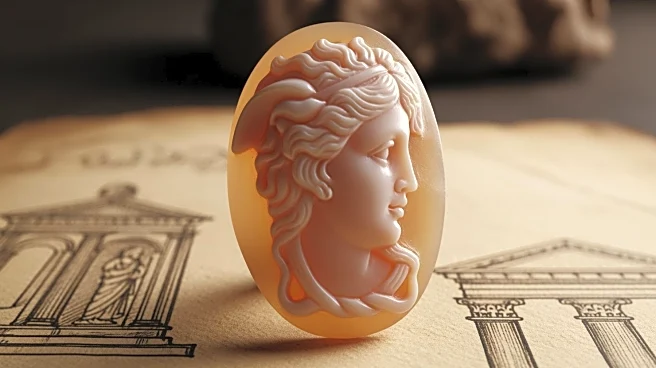
A rare Roman cameo relief depicting the goddess Medusa has been unearthed at a construction site in Hallstatt, Austria. The artifact, a finely carved banded agate relic, was discovered during excavation work for a new funicular railway system. Dated to
the 2nd century C.E., the cameo is considered one of the most significant finds from antiquity in Upper Austria. It was likely crafted in a northern Adriatic workshop and sold as jewelry in Hallstatt, a village with a rich history of Roman salt mining. The Medusa cameo, which measures just 1.5 cm, is believed to have been worn by an elite Roman woman. It will be displayed at the Cultural and Congress House in Hallstatt before becoming part of the permanent archaeology collection at Linz Castle Museum.
Why It's Important?
The discovery of the Medusa cameo underscores the historical depth and cultural heritage of the Hallstatt region. Such archaeological finds provide valuable insights into the Roman era, particularly in the province of Noricum. The cameo's intricate craftsmanship and historical context enrich the understanding of Roman influence in Upper Austria. This find also highlights the importance of archaeological work in uncovering and preserving historical artifacts, which contribute to the cultural and educational landscape. The cameo's addition to the Linz Castle Museum's collection will enhance public access to and appreciation of ancient history.
What's Next?
The Medusa cameo will be part of a permanent exhibition at the Linz Castle Museum, allowing for ongoing public engagement and educational opportunities. The construction of the funicular railway, which led to the discovery, is set to continue, potentially uncovering more artifacts. The project emphasizes the need for careful archaeological oversight in construction projects, particularly in historically rich areas. Future excavations in Hallstatt may reveal additional insights into the region's Roman past, further contributing to the historical narrative of the area.