







What's Happening?
UNESCO has announced the inscription of three significant documentary heritage items from India onto the Memory of the World Committee for Asia and the Pacific (MOWCAP) regional register. This decision was made during the 11th General Meeting of MOWCAP,
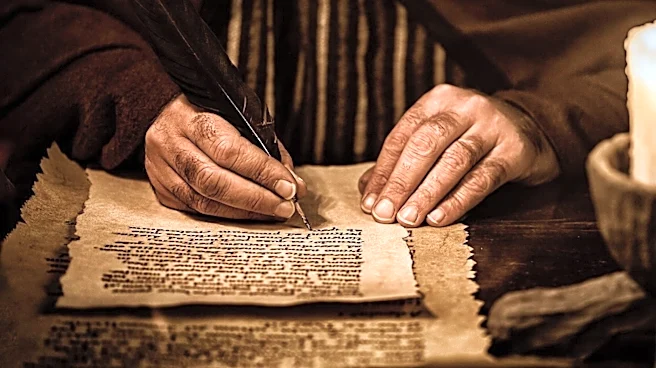
which reviewed nominations for the 2025–2026 cycle. The newly added items include Kautilya's Arthaśāstra, an ancient foundational treatise on governance and statecraft; the Birch-Bark (būrjapatra) Manuscript of Mahābhārata, a perennial epic of South Asia; and Kalhaṇa's Manuscript of Rājataraṅgiṇī, a twelfth-century chronicle of Kashmir. The Arthaśāstra, composed two millennia ago, is a Sanskrit text on statecraft, economics, and military strategy, preserved in a sixteenth-century palm-leaf manuscript. The Mahābhārata manuscript, a 400-year-old birch-bark text in Śāradā script, is considered a codex archetype. The Rājataraṅgiṇī manuscript, written in Śāradā script on old Kashmiri paper, is a direct copy of a lost original, offering a continuous history of Kashmir. These inscriptions bring India's total entries on the regional register to six, contributing to the register's current listing of 106 items from 29 countries.
Why It's Important?
The inscription of these ancient Indian texts on UNESCO's Memory of the World regional register underscores their profound historical, cultural, and intellectual significance not only for India but for the broader Asia-Pacific region and global heritage. The Arthaśāstra provides invaluable insights into ancient governance, economic principles, and diplomatic strategies, offering a historical blueprint for statecraft that remains relevant for comparative studies in political science and economics. The Mahābhārata, as one of the world's longest epics, is a cornerstone of South Asian civilization, influencing art, philosophy, and moral ethics across the continent for centuries. Its preservation ensures continued access to a narrative that explores fundamental human dilemmas and societal structures. The Rājataraṅgiṇī offers a rare example of historical consciousness in ancient South Asian literature, providing a detailed chronicle of Kashmir's past. These inscriptions highlight the importance of preserving documentary heritage as a collective memory of humanity, fostering international cooperation in safeguarding rare and endangered materials. For scholars and researchers, these texts offer primary sources for understanding ancient societies, while for the public, they represent a tangible link to a rich cultural past, promoting appreciation for diverse intellectual traditions.
What's Next?
Following these inscriptions, UNESCO's Memory of the World Programme will continue its efforts to promote international cooperation in safeguarding, preserving, and facilitating access to documentary heritage. The recognition of these Indian texts may lead to increased scholarly interest, further research, and potential digitization projects to make these valuable manuscripts more accessible globally. Educational institutions and cultural organizations may leverage this recognition to develop new curricula, exhibitions, and public awareness campaigns centered on these historical documents. Furthermore, the inscription could encourage other nations in the Asia-Pacific region to identify and nominate their own significant documentary heritage for inclusion in the register, thereby enriching the collective memory of the region. UNESCO will likely continue to monitor the preservation status of these inscribed items and provide support for their long-term conservation. The program's ongoing work aims to ensure that these irreplaceable records of human history and knowledge are protected for future generations, fostering a deeper understanding of shared cultural legacies.
Beyond the Headlines
The inscription of these ancient Indian texts on UNESCO's Memory of the World register extends beyond mere recognition; it highlights the enduring relevance of historical knowledge in contemporary society. The Arthaśāstra, for instance, offers timeless principles of governance and statecraft that can be analyzed through modern lenses, providing historical context for discussions on political ethics, economic policy, and international relations. The Mahābhārata's exploration of dharma, duty, and human destiny continues to resonate, offering profound philosophical insights that transcend cultural boundaries and contribute to global ethical discourse. The Rājataraṅgiṇī underscores the importance of historical record-keeping and critical analysis in understanding societal evolution and conflict. This recognition also implicitly emphasizes the fragility of documentary heritage and the continuous need for dedicated efforts in conservation, particularly in an era where digital preservation and access are paramount. It reinforces the idea that understanding our past, through such meticulously preserved documents, is crucial for navigating present challenges and shaping future trajectories, fostering a global appreciation for the diverse intellectual contributions of civilizations throughout history.