

What's Happening?
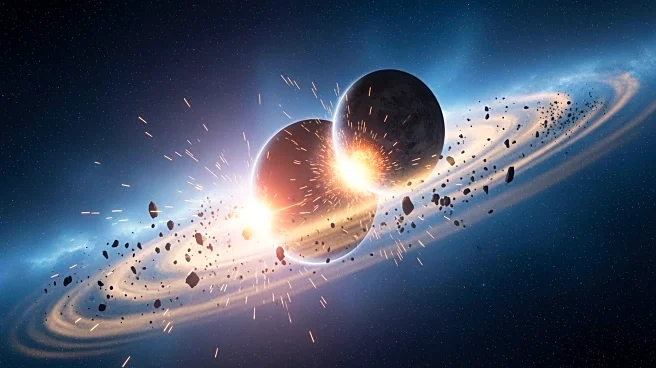
Astronomers have observed a significant collision between two planets in a distant star system, which may lead to the formation of new dwarf planet candidates. The event was detected around the star Gaia20ehk, located approximately 11,000 light-years
away. This star, typically stable, began exhibiting unusual behavior in 2016, with significant dips in brightness observed by researchers. These fluctuations were attributed to debris from the collision of two planets orbiting the star. The collision is reminiscent of the impact that formed Earth's moon, suggesting that the scattered material could eventually cool and coalesce into new planetary bodies. The discovery was made possible through observations using various telescopes, capturing the event in real-time, which is a rare occurrence in astronomy.
Why It's Important?
This discovery is significant as it provides a rare opportunity to study planetary collisions, which are believed to be common in the early stages of planetary system formation. Understanding these events can offer insights into the processes that lead to the formation of planets and moons, similar to those in our solar system. The potential formation of new planetary bodies from this collision could help scientists understand the conditions necessary for the development of life-supporting environments. Additionally, studying such collisions can shed light on the frequency and nature of similar events in the galaxy, contributing to the field of astrobiology and the search for life beyond Earth.
What's Next?
While the formation of new planetary bodies from this collision could take millions of years, astronomers are keen to observe similar events elsewhere in the galaxy. The data collected from this event will be used to refine models of planetary formation and collision dynamics. Future telescopes, such as the Vera C. Rubin Observatory, are expected to play a crucial role in detecting more such events, allowing for a better understanding of the frequency and impact of planetary collisions. This ongoing research could eventually answer fundamental questions about the formation of our own solar system and the potential for life on other planets.
Beyond the Headlines
The implications of this discovery extend beyond immediate scientific interest. The study of planetary collisions and their outcomes can influence our understanding of the conditions necessary for life. The presence of a moon, for example, is thought to have played a crucial role in the development of life on Earth by stabilizing the planet's tilt and creating tidal forces. Understanding how common such moon-forming events are could provide insights into the likelihood of life elsewhere in the universe. This research also highlights the importance of continued investment in astronomical observation technologies to uncover the mysteries of planetary system evolution.