



What's Happening?
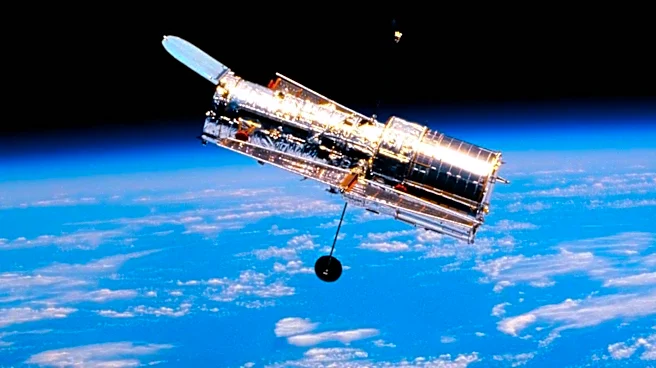
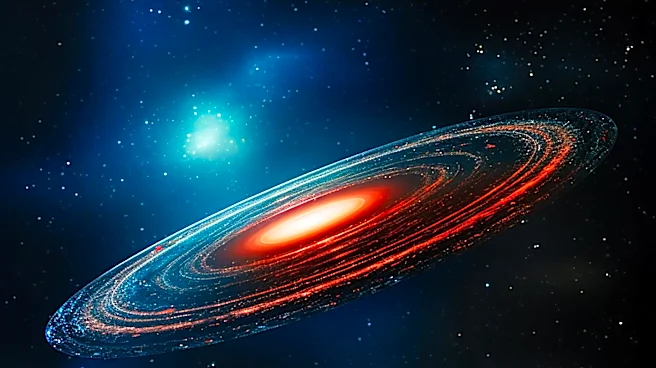
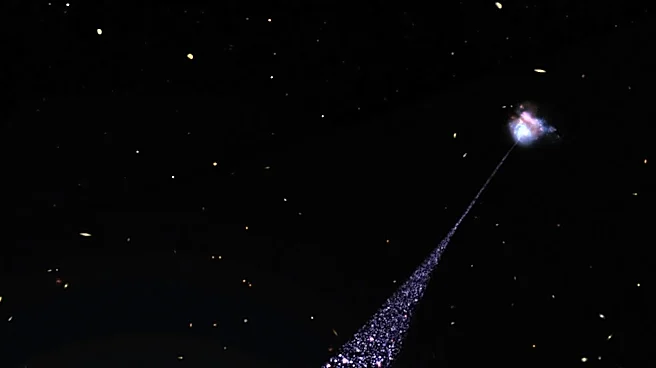
NASA's Neil Gehrels Swift Observatory has observed a rare event where a supermassive black hole, located far from the center of its galaxy, devours a star. This phenomenon, known as a tidal disruption event, was detected in a galaxy approximately 750
million light-years away. The event was first identified by the Zwicky Transient Facility in November 2025 and later confirmed by Swift's observations. The black hole, with a mass about a million times that of the Sun, caused an ultrabright flare as it tore apart the star. This discovery is significant as it validates a new technique for identifying wandering black holes, which are typically found at the centers of galaxies.
Why It's Important?
The observation of this tidal disruption event is crucial for understanding the behavior of supermassive black holes that do not reside in the centers of galaxies. Such events are rare, and their study can provide insights into the dynamics of galaxies and the role of black holes in galactic evolution. The ability to detect these events using new techniques could lead to the discovery of more wandering black holes, enhancing our understanding of their prevalence and impact on their host galaxies. This research also highlights the potential for future observations with upcoming telescopes to expand our knowledge of the universe's black holes.
What's Next?
Future observations using the Vera C. Rubin Observatory and NASA's Nancy Grace Roman Space Telescope are expected to further explore these phenomena. These telescopes will allow scientists to search for more tidal disruption events and wandering black holes, potentially leading to a more comprehensive understanding of their distribution and behavior. Additionally, the Swift Observatory is awaiting an orbit boost to extend its operational life, which will enable continued observations of such cosmic events.