
What's Happening?
NASA's Curiosity rover has discovered a diverse collection of organic molecules on Mars, including seven carbon-containing compounds never before detected on the planet. The findings, published in Nature
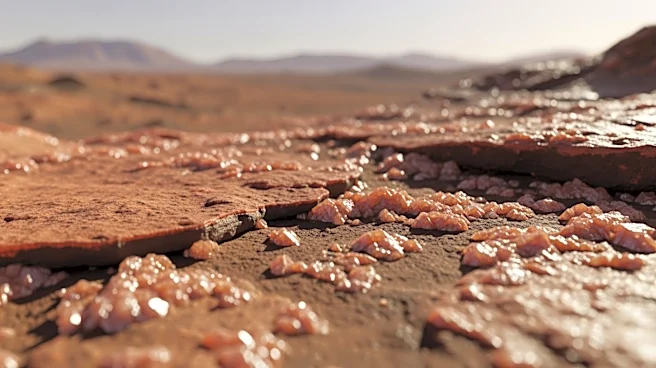
Communications, were made from a rock sample collected in 2020 at a site known as 'Mary Anning 3' on Mount Sharp. This area was once covered by lakes and streams, which enriched it with clay minerals capable of preserving organic compounds. Among the newly identified molecules is a nitrogen heterocycle, a structure considered a precursor to RNA and DNA. The discovery of these molecules, which could have been formed by either biological or geological processes, suggests that ancient Mars had the right chemistry to support life. The research was conducted using the Sample Analysis at Mars (SAM) instrument, which employs a high-temperature oven to analyze rock samples.
Why It's Important?
The discovery of these organic molecules is significant as it enhances the understanding of Mars' potential to have supported life in its ancient past. The presence of nitrogen heterocycles, which are precursors to essential biological molecules like RNA and DNA, indicates that the building blocks of life could have existed on Mars. This finding contributes to the growing body of evidence that Mars once had conditions suitable for life, which is crucial for future exploration missions. The research also demonstrates the capabilities of the Curiosity rover and its instruments, paving the way for more advanced studies in astrobiology and the search for extraterrestrial life.
What's Next?
The Curiosity team plans to continue analyzing the results from the SAM instrument, particularly focusing on the second and final use of the TMAH cup, which was recently employed to study weblike boxwork ridges formed by ancient groundwater. These findings will be detailed in a future peer-reviewed paper. Additionally, the techniques and technologies developed for this mission are expected to be utilized in future Mars missions and other planetary explorations, including the European Space Agency's Rosalind Franklin rover and NASA's Dragonfly mission to Saturn's moon Titan.