







What's Happening?
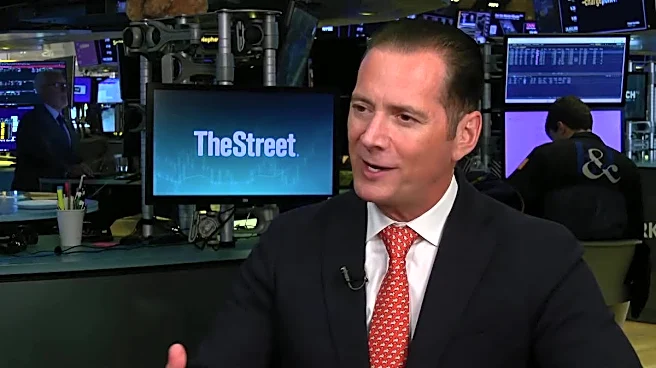
Jeff Schmid, President of the Kansas City Federal Reserve Bank, has emphasized the importance for the Federal Reserve System to evaluate whether the burgeoning artificial intelligence (AI) industry and its associated network of companies and contracts
are developing into a systemic risk, potentially becoming 'too big to fail.' Schmid raised this concern amidst the rapid growth of the AI sector and the construction of numerous data centers. He highlighted the need for the Federal Reserve to understand the internal structure of this evolving AI ecosystem to determine if its scale could render it too critical to the economy to be allowed to collapse without significant repercussions. This call for assessment is rooted in the potential for an AI ecosystem to reach a point where its failure could necessitate government intervention, similar to the financial crisis of 2007–2009.
Why It's Important?
The call from Kansas City Fed President Jeff Schmid to assess systemic risks within the AI industry is crucial for U.S. financial stability and economic policy. The rapid expansion of AI, coupled with the substantial investments in data centers and interconnected companies, presents a new frontier for potential economic vulnerabilities. If a significant portion of the economy becomes reliant on a few large AI entities, their failure could trigger widespread disruptions, impacting various sectors from technology and finance to manufacturing and services. This situation could lead to job losses, market instability, and a need for government bailouts, placing a heavy burden on taxpayers. Understanding these risks proactively allows regulators to develop appropriate frameworks and safeguards, preventing a future crisis rather than reacting to one. It also highlights the evolving nature of systemic risk, moving beyond traditional financial institutions to encompass critical technological infrastructures.
What's Next?
Following President Schmid's remarks, the Federal Reserve System is likely to initiate or intensify discussions and research into the systemic risks posed by the AI ecosystem. This could involve forming specialized working groups, commissioning detailed studies on the interconnectedness of AI companies and their economic impact, and engaging with industry leaders to gather data and insights. Policymakers may explore potential regulatory frameworks or oversight mechanisms to monitor the growth and stability of the AI sector. The focus will be on identifying key vulnerabilities, such as concentration of power, data security risks, and the potential for cascading failures within the AI supply chain. The goal will be to develop strategies that promote innovation in AI while mitigating potential threats to the broader economy, possibly leading to new guidelines or policies for AI development and deployment.
Beyond the Headlines
Beyond the immediate financial implications, President Schmid's concerns about AI's systemic risks touch upon deeper societal and ethical considerations. The concept of an AI ecosystem becoming 'too big to fail' raises questions about market concentration, competition, and the potential for a few dominant players to exert undue influence over critical infrastructure and information flows. This could lead to ethical dilemmas regarding data privacy, algorithmic bias, and the responsible development of powerful AI technologies. Furthermore, the integration of AI into various aspects of daily life and critical services means that a systemic failure could have profound impacts on public trust, national security, and social equity. Addressing these risks requires a multidisciplinary approach, involving not only financial regulators but also ethicists, technologists, legal experts, and civil society, to ensure that AI development aligns with broader societal values and long-term stability.