
What's Happening?
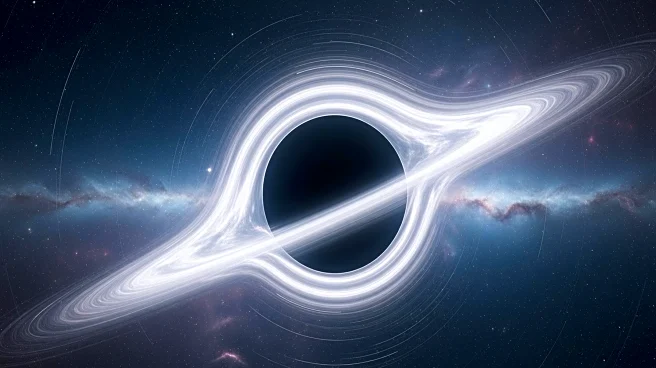
Astronomers have observed a supermassive black hole exhibiting a rare phenomenon known as 'Lense-Thirring precession' or 'frame dragging,' where the black hole's rapid spin drags the fabric of space and
time around it. This observation was made while studying a star being torn apart by the black hole, a process known as a tidal disruption event (TDE). The study utilized data from NASA's Neil Gehrels Swift Observatory and the Karl G. Jansky Very Large Array. The findings provide compelling evidence of the frame-dragging effect, a concept first predicted by Albert Einstein's theory of general relativity in 1915 and later expanded by physicists Josef Lense and Hans Thirring in 1918.
Why It's Important?
This discovery is significant as it provides a new method for studying the spin of black holes and the dynamics of tidal disruption events. Understanding these phenomena can offer insights into the behavior of matter under extreme gravitational forces and the mechanics of black holes. The confirmation of frame-dragging also reinforces Einstein's theory of general relativity, which has been a cornerstone of modern physics. This research could lead to advancements in astrophysics, particularly in understanding how black holes influence their surroundings and the universe's structure.
What's Next?
Further analysis of the data from this observation could enhance our understanding of the Lense-Thirring effect and the physics of black holes. Scientists may continue to use similar methods to study other black holes and tidal disruption events, potentially uncovering more about the universe's fundamental forces. This research could also inspire new technologies or methodologies in space observation and astrophysics.
Beyond the Headlines
The observation of frame-dragging not only confirms theoretical predictions but also highlights the intricate relationship between mass, gravity, and spacetime. This discovery could influence future research in gravitational physics and cosmology, potentially leading to new theories or modifications of existing ones. It also underscores the importance of continued investment in space exploration and technology to uncover the universe's mysteries.