




What's Happening?
The University of the Philippines Resilience Institute-National Operational Assessment of Hazards (UPRI-NOAH) Center has secured a ₱1 billion allocation to expand its science-based tools for disaster and climate solutions. This funding aims to help the government
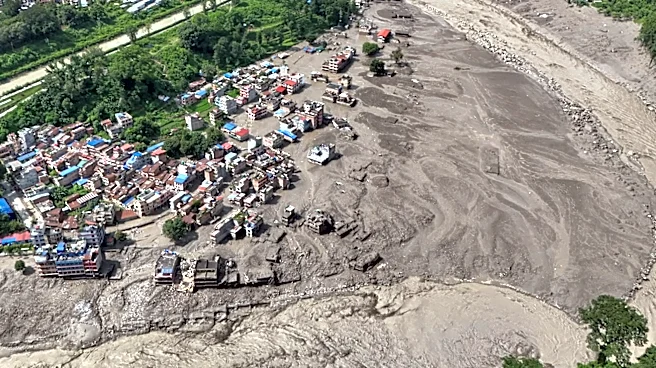
make more informed decisions before natural disasters occur. According to UPRI-NOAH Executive Director Mahar Lagmay, the country continues to face significant flooding and other hazards despite substantial government spending on disaster risk reduction. Lagmay emphasized the need to better understand the underlying issues and why existing interventions have not been sufficient. The Philippines is prone to various hazards, including storm surges, subsidence, volcanic and earthquake hazards, and landslides, in addition to flooding. The UPRI-NOAH's work focuses on operational research, integrating scientific outputs directly into government efforts to ensure immediate application. UP President Angelo A. Jimenez highlighted that this allocation is an investment in the university's belief in the power of research and innovation to serve the nation, ensuring that knowledge generated addresses real-world problems and improves lives.
Why It's Important?
This significant investment in UPRI-NOAH's capabilities is crucial for the Philippines, a nation highly vulnerable to natural disasters. By expanding hazard mapping, flood modeling, and other science-based tools, the country can move towards more proactive and effective disaster preparedness and response. The current situation, where substantial funds have been spent on disaster risk reduction without fully mitigating impacts, underscores the importance of evidence-based decision-making. Integrating scientific research directly into government operations means that interventions can be tailored to specific local conditions, potentially saving lives and reducing economic losses. The focus on operational research ensures that scientific findings are not merely academic but are translated into actionable strategies. This initiative also highlights the critical role of academic institutions in national development and resilience-building, fostering a stronger link between research and public service. Improved disaster management will protect vulnerable communities, infrastructure, and the national economy from the devastating effects of climate change and natural hazards.
What's Next?
The ₱1 billion allocation will support several key initiatives. UPRI-NOAH plans to conduct high-resolution mapping of major river basins, with hazard maps reaching up to one-by-one-meter pixel resolution. This detailed mapping will document waterways, floodplains, land use, watersheds, infrastructure, and communities exposed to hazards. The center will also simulate major detention basins to assess their storage capacity, drainage connectivity, and performance under extreme rainfall and future climate conditions. Under 'Oplan Kontra Baha,' UPRI-NOAH will collaborate with the Department of Public Works and Highways, Metropolitan Manila Development Authority, local governments, and the private sector to evaluate appropriate structural and non-structural flood-management measures. Other planned initiatives include LiDAR drone surveys with state colleges and universities, mapping native trees, assessing sediment erosion, identifying undocumented waterways, developing nature-based solutions, and applying artificial intelligence for disaster management. These efforts aim to develop decision-support tools for land-use and infrastructure planning, environmental management, and risk analysis, ultimately leading to safer communities and more informed public investments.
Beyond the Headlines
The initiative extends beyond technological advancements, emphasizing that technology alone cannot create resilient communities. As Lagmay stressed, the effectiveness of science and engineering depends on public embrace and understanding. This highlights the critical role of communication and community engagement in disaster preparedness. The UP Resilience Institute recognizes the need to integrate arts and humanities to effectively communicate scientific findings and encourage public participation in resilience efforts. This holistic approach acknowledges that societal resilience is not just about infrastructure and data but also about collective action, informed decision-making at the local level, and a shared understanding of risks. The project's success will depend on its ability to bridge the gap between scientific expertise and community action, fostering a culture of preparedness and adaptability. Furthermore, the use of AI-assisted benefit-cost assessments will help decision-makers prioritize projects based on their effectiveness, sustainability, and potential to protect the greatest number of people, moving beyond guesswork to evidence-guided public investment.