


What's Happening?
The construction of the Central Pacific Railroad, which began in January 1863 from Sacramento eastward, faced a significant labor shortage in California. Initially, Irish immigrants were considered, but their interest in the arduous work of crossing the territory
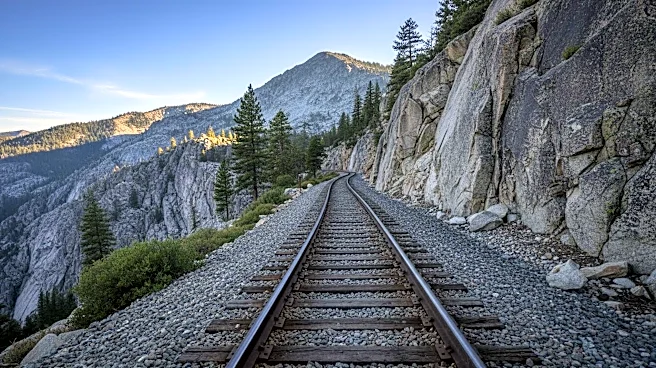
was limited. A supervisor for the Central Pacific then proposed employing Chinese immigrants settled in the Sacramento Valley. Despite the extreme difficulty of working in the Sierra Nevada mountains, the railroad officials believed the Chinese workers, known for their historical feat of building the Great Wall, would be capable. After a trial period, the results were so positive that an expedition was sent to China to recruit more laborers. Ultimately, over ten thousand Chinese immigrants were instrumental in carving a path through the mountainous terrain. This effort involved the daily use of up to 500 barrels of explosives, and more than 1,500 Asian employees perished in explosions and rockfalls while overcoming the Sierra Nevada obstacle. Once this natural barrier was surmounted, the pace of track laying accelerated dramatically, from 25 centimeters to nearly 10 kilometers per day, requiring 21 million hammer blows in total.
Why It's Important?
The reliance on Chinese immigrant labor for the Central Pacific Railroad was a critical factor in the completion of the First Transcontinental Railroad, a monumental engineering achievement that profoundly reshaped the United States. This project was vital for connecting the burgeoning Pacific coast with the existing railway network reaching the Missouri River, thereby facilitating the industrial supply of raw materials, particularly gold from California, and enabling the occupation of vast virgin lands. The railroad's completion drastically reduced travel time across the continent from six months to three days, fostering national unity and economic integration. The immense human cost, with over 1,500 Asian workers dying during construction, highlights the harsh conditions and sacrifices made by immigrant communities in building American infrastructure. This historical event underscores the significant, often overlooked, contributions of Chinese immigrants to the nation's development and the complex social dynamics of the era, including the exploitation of labor.
What's Next?
The completion of the Transcontinental Railroad in 1869 at Promontory Point, Utah, marked a new era for the United States. Following this initial success, the entrepreneurs behind the Central Pacific and Union Pacific railroads rapidly expanded the national rail network. Within four decades, the U.S. boasted over 300,000 kilometers of railway tracks. This expansion transformed the national economy, allowing small settlements to thrive by providing access to necessary goods and services, and fostering the growth of a national market that would eventually become the world's largest. The increased connectivity led to a doubling of the population and a tripling of cities by the early 20th century, with freight trains transporting significantly more goods. This infrastructure laid the groundwork for the United States to emerge as a new global power, fundamentally altering its economic, social, and geographical landscape.
Beyond the Headlines
The story of the Central Pacific Railroad's construction, particularly its reliance on Chinese labor, reveals deeper implications regarding immigration, labor rights, and the perception of minority groups in 19th-century America. The initial reluctance to employ Chinese workers, followed by their extensive recruitment due to their perceived work ethic and the sheer necessity of labor, illustrates the pragmatic yet often discriminatory attitudes of the time. The dangerous working conditions and high mortality rates among Chinese laborers, contrasted with the eventual celebration of the railroad's completion, highlight a historical pattern where the contributions of immigrant communities were essential but their sacrifices often marginalized. This period also set precedents for large-scale infrastructure projects and the role of government financing, as President Lincoln's administration issued bonds backed by future railroad profits and land sales. The railroad's impact extended beyond transportation, influencing the displacement of Native American tribes and the transformation of the American West, marking a significant shift in the nation's cultural and environmental landscape.