


What's Happening?
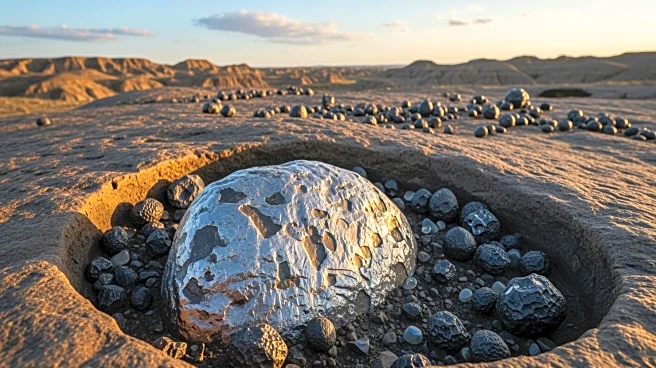
Researchers in Brazil have discovered a field of tektites, which are natural glass formations created by the intense heat of a meteorite impact. This discovery marks the first identification of such a field in Brazil, specifically in the state of Minas
Gerais. The study, led by Professor Álvaro Penteado Crósta from the University of Campinas, was published in the journal 'Geology'. The tektites, which are formed when terrestrial rocks melt and solidify into glass, were found to contain high levels of silicon dioxide and other trace elements. The isotopic geochemistry suggests that the molten material originated from ancient continental crust dating back 3 to 3.3 billion years. The impact event is estimated to have occurred about 6.3 million years ago, at the end of the Miocene epoch. The field extends over 900 kilometers, indicating a significant impact event.
Why It's Important?
The discovery of the tektite field in Brazil adds to the global understanding of meteorite impacts and their effects on Earth's geology. This finding is significant as it joins only five other major tektite fields identified worldwide, including those in Australasia and North America. The research provides insights into the composition and distribution of tektites, which can help scientists understand the conditions and consequences of ancient impact events. The study also highlights the potential for further discoveries in Brazil, which could lead to a better understanding of the Earth's geological history and the processes that have shaped its surface. This research could have implications for the study of planetary geology and the history of meteorite impacts on Earth.
What's Next?
Further research is likely to focus on expanding the understanding of the Brazilian tektite field. Scientists may conduct additional geochemical analyses and field studies to determine the full extent of the field and the characteristics of the impacting body. There is also potential for discovering more tektite fields in other regions of Brazil, which could provide further insights into the history of meteorite impacts in South America. The findings may prompt international collaboration to compare the Brazilian field with other known fields, enhancing the global knowledge of tektite formation and distribution.
Beyond the Headlines
The discovery of the tektite field in Brazil not only contributes to geological science but also raises questions about the impact of such events on ancient ecosystems and climate. Understanding the frequency and scale of meteorite impacts can provide context for current discussions on planetary defense and the potential risks posed by future impacts. Additionally, the study of tektites can offer clues about the conditions on early Earth and the processes that may have influenced the development of life.