



What's Happening?
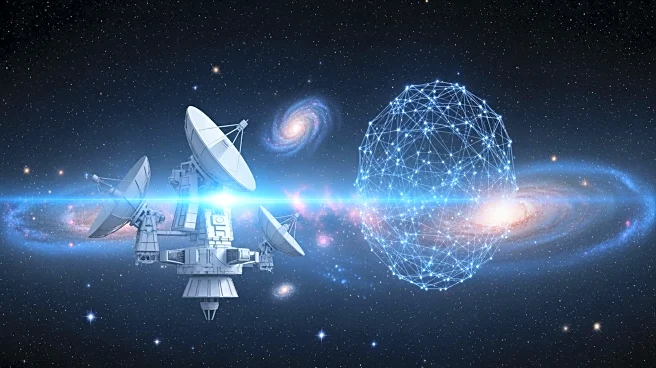
NASA has proposed a new mission concept called the 'Cosmic Positioning System' (CPS) aimed at resolving the 'Hubble Tension'—a discrepancy in the measured rate of the universe's expansion. The CPS would involve a network of five satellites spread throughout
the solar system, using a technique similar to GPS triangulation to measure distances to far-off cosmic objects. This system is designed to provide more accurate measurements of the Hubble constant, which currently varies depending on the method used. The CPS would require significant engineering feats, including large deployable antennas and advanced atomic clocks, to function effectively in the vast distances of space.
Why It's Important?
The Hubble Tension presents a significant challenge in cosmology, affecting our understanding of the universe's expansion rate and age. Resolving this tension could refine the standard cosmological model and improve distance measurements to celestial objects. The CPS, if realized, could also contribute to other scientific objectives, such as analyzing dark matter and detecting gravitational waves. This mission represents a potential leap in space exploration technology, offering insights into fundamental cosmic phenomena and possibly confirming the existence of hypothetical entities like Planet 9.
What's Next?
Currently, the CPS is in the conceptual phase under NASA's Institute for Advanced Concepts (NIAC) program, which explores cutting-edge technologies. The project has not yet received additional funding, and its future depends on further interest and investment from the space exploration community. If developed, the CPS could become a pivotal tool in cosmology, but it remains a theoretical proposal until further advancements and funding are secured.
Beyond the Headlines
The CPS project highlights the ongoing challenges in measuring cosmic distances and the need for innovative solutions in space science. It underscores the importance of international collaboration and investment in space technology to address fundamental questions about the universe. The project's success could pave the way for future missions that explore the outer solar system and beyond, potentially transforming our understanding of space and time.