





What's Happening?
Taiwan is actively fortifying the Penghu archipelago, a strategically vital cluster of 90 islands, in anticipation of a potential Chinese attack. Military assessments indicate that Penghu would likely bear the initial brunt of an invasion attempt. The
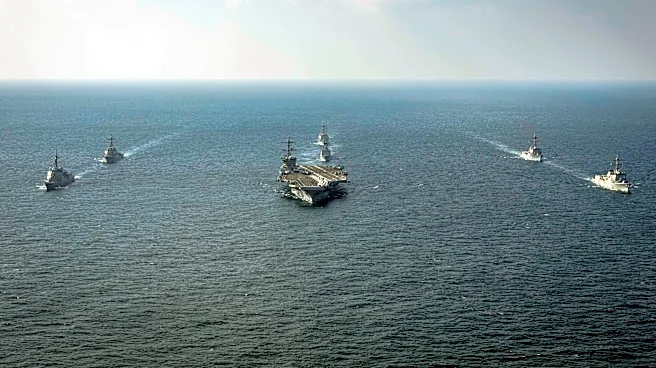
Taiwanese military is conducting exercises on the islands, practicing the repulsion of amphibious landings using tanks, artillery, mortars, and infantry. Notably, Hsiung Feng III mobile anti-ship missile systems have been deployed to Penghu for the first time, and a drone unit was established in July. These measures aim to complicate the People's Liberation Army's ability to amass forces along the coast and to counter the Chinese navy's advance towards Taiwan's main island. China's Ministry of Defense has previously dismissed Taiwan's fortification plans as "absurd and delusional," warning of severe consequences if Taiwan provokes a conflict. Last year, command-post exercises involving U.S., Taiwanese, and Japanese retired officers simulated Penghu falling within a day of a Chinese surprise attack, highlighting the urgency of these defensive preparations.
Why It's Important?
The fortification of Penghu is a critical component of Taiwan's asymmetric defense strategy, designed to deter or significantly complicate a Chinese invasion. By deploying longer-range weapons and enhancing defensive capabilities on these frontline islands, Taiwan aims to create a formidable barrier that could inflict substantial costs on an invading force. This strategy is vital for Taiwan's national security, as the loss of Penghu would effectively grant China control over the entire Taiwan Strait, severely compromising Taiwan's defense. For the U.S., which operates under the Taiwan Relations Act to provide for Taiwan's defense, these efforts are significant. A stronger, more resilient Taiwan reduces the likelihood of a successful invasion, thereby lessening the potential for a broader regional conflict that could draw in U.S. forces. The U.S. has also approved substantial military aid packages to Taiwan, underscoring its commitment to supporting Taiwan's self-defense. The increased military activity and rhetoric in the region elevate geopolitical tensions, impacting international shipping lanes and global economic stability, given Taiwan's crucial role in the global technology supply chain.
What's Next?
Taiwan is expected to continue its military exercises and further integrate its new drone capabilities and missile systems into its defense strategy for Penghu. This will likely involve ongoing training for personnel and potential upgrades to existing infrastructure. China will undoubtedly monitor these developments closely, and its responses could range from increased military drills in the Taiwan Strait to heightened diplomatic pressure. The U.S. will likely continue its support for Taiwan's defense, potentially through further intelligence sharing, military aid, and joint exercises, while carefully navigating its 'One China' policy. The international community will be watching for any escalation of tensions, as the situation in the Taiwan Strait has significant implications for global security and trade. The effectiveness of Taiwan's asymmetric defense strategy will be a key factor in deterring potential aggression and maintaining regional stability.
Beyond the Headlines
The fortification of Penghu highlights the broader strategic importance of island chains in modern geopolitical conflicts. These islands serve not only as defensive outposts but also as potential chokepoints for naval and air movements. Taiwan's investment in advanced missile systems and drone technology reflects a global trend towards leveraging technological superiority and asymmetric warfare tactics to counter larger conventional forces. This shift raises questions about the future of naval warfare and the role of unmanned systems in defense. Furthermore, the ongoing tensions underscore the complex diplomatic dance surrounding Taiwan's sovereignty, with China asserting its 'One China' principle and the U.S. maintaining strategic ambiguity while supporting Taiwan's self-defense. The economic implications are also profound, as any conflict in the Taiwan Strait would disrupt global supply chains, particularly for semiconductors, leading to widespread economic repercussions. The situation also serves as a test case for international norms regarding self-determination and the use of force in international relations.