
What's Happening?
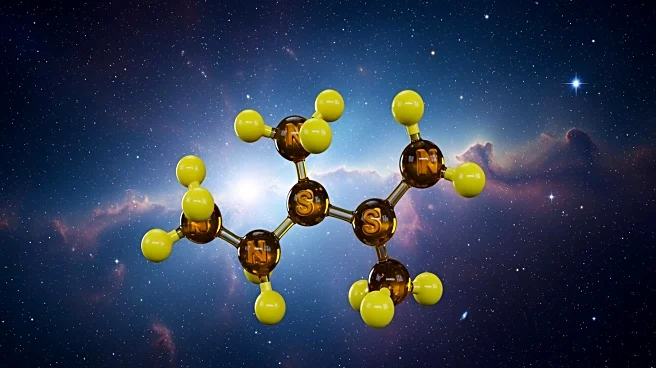
Researchers at the Max Planck Institute for Extraterrestrial Physics, in collaboration with the Centro de Astrobiología, have identified the largest sulfur-bearing molecule ever found in space: 2,5-cyclohexadiene-1-thione
(C₆H₆S). This discovery was made by combining laboratory experiments with astronomical observations. The molecule was detected in the molecular cloud G+0.693–0.027, located about 27,000 light-years from Earth near the center of the Milky Way. The molecule's structure is similar to those found in extraterrestrial samples, establishing a chemical link between the interstellar medium and our solar system.
Why It's Important?
The discovery of this complex sulfur-bearing molecule is a significant advancement in astrochemistry, providing insights into the chemical processes that occur in space. Sulfur is a crucial element in proteins and enzymes, and the presence of such complex molecules in interstellar space suggests that the building blocks of life may form long before stars and planets. This finding bridges a gap in our understanding of the chemical evolution from simple interstellar molecules to the complex organic compounds found in comets and meteorites, which are considered precursors to life on Earth.
Beyond the Headlines
The detection of C₆H₆S highlights the potential for many more complex sulfur-bearing molecules to exist in space, which remain undetected. This discovery underscores the importance of continued astronomical observations and laboratory experiments to uncover the chemical diversity of the universe. Understanding these processes could provide valuable insights into the origins of life and the conditions necessary for life to develop elsewhere in the universe.