


What's Happening?
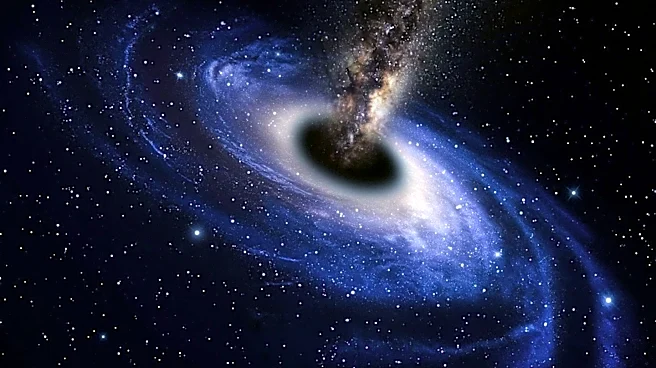
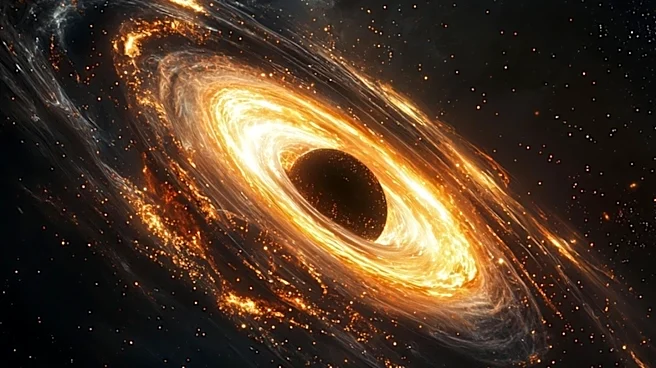
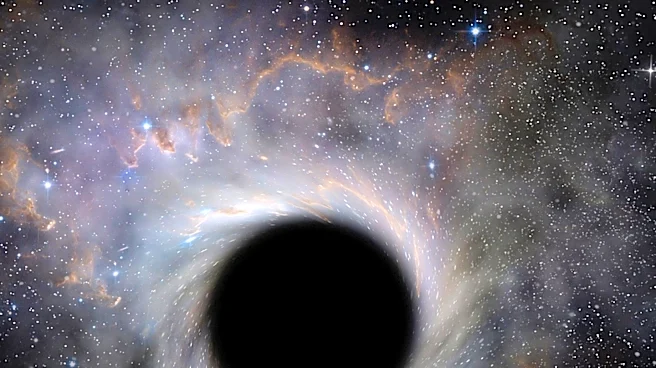
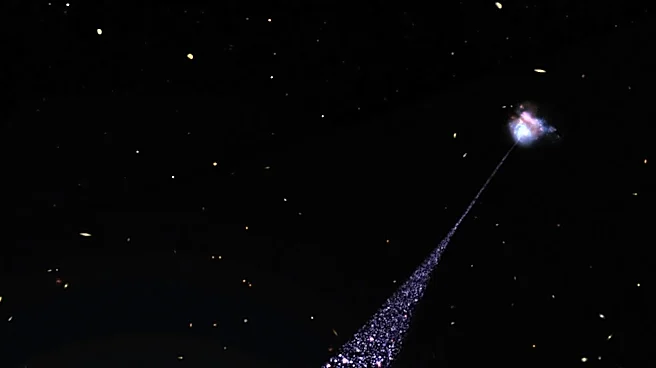
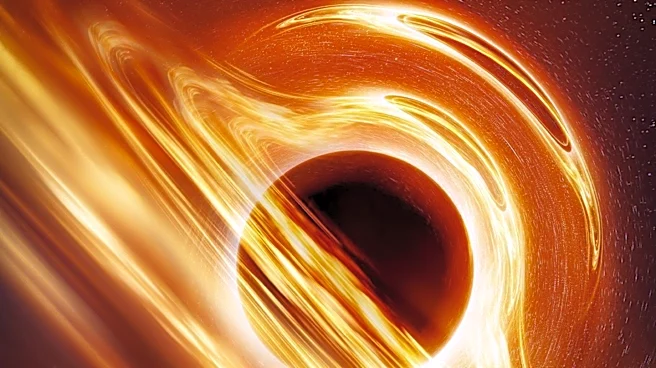
A new study by researchers from Yale and the University of North Texas investigates a class of black holes known as 'wanderers,' which are not supermassive and are not gravitationally bound to any specific galaxy, instead traveling through the cosmos
for billions of years. The study, led by Emma Jane Weller, an Astronomy PhD candidate at Yale University, explores the hypothesis that these wandering black holes originated as supermassive black holes at the centers of galaxies but were displaced during galactic mergers. The research utilized the ASTRID cosmological simulation suite, which models the evolution of the universe, including stars, dark matter, gas, and black holes, from its earliest periods to the present. This simulation allowed the team to differentiate between stable, galactic-core black holes and these displaced wanderers, by modeling the gravitational forces that move black holes through their surroundings.
Why It's Important?
This research is significant because it offers new insights into the origins and dynamics of massive black holes and the evolutionary histories of their host galaxies. By distinguishing between black holes that remain at galactic centers and those that wander, scientists can disentangle the complex processes that shape galaxies. The study suggests that wandering black holes carry an imprint of the events that have occurred in their host galaxies, making them valuable clues to understanding galactic mergers and the distribution of dark matter. The findings indicate that the process leading to wandering black holes is more pronounced in low-mass galaxies, where their gravitational influence is less dominant. This understanding is crucial for developing a more comprehensive approach to studying black hole formation and galaxy evolution, moving beyond the traditional focus solely on central black holes.
What's Next?
The findings from this study provide a framework for future research into black hole origins and galaxy evolution. Researchers anticipate combining these simulation results with various observational methods, including deep X-ray observations, optical and infrared spectroscopy, radio astronomy, and the detection of transient 'flares' caused by black holes consuming stars. This multi-faceted approach aims to identify the distinct imprints of black hole formation and galaxy evolution. Further studies will likely focus on refining the ASTRID simulation to explore different scenarios of galactic mergers and their impact on black hole displacement. The goal is to develop a more complete picture of how black holes, both central and wandering, contribute to the cosmic web and the overall structure of the universe.
Beyond the Headlines
The concept of 'wandering black holes' challenges the conventional view of black holes as static entities at galactic cores, revealing a more dynamic and complex cosmic landscape. This research touches upon fundamental questions about the nature of gravity, the distribution of dark matter, and the long-term evolution of galaxies. The idea that black holes 'remember' the circumstances of their birth and the history of their host galaxies adds a new layer of complexity to astrophysical studies. It also highlights the importance of high-resolution cosmological simulations in uncovering phenomena that might be difficult to observe directly. The potential for these wandering black holes to provide clues about the universe's earliest 'seed' black holes and their growth into supermassive entities could revolutionize our understanding of the early universe and the mechanisms that drove its development.