



What's Happening?
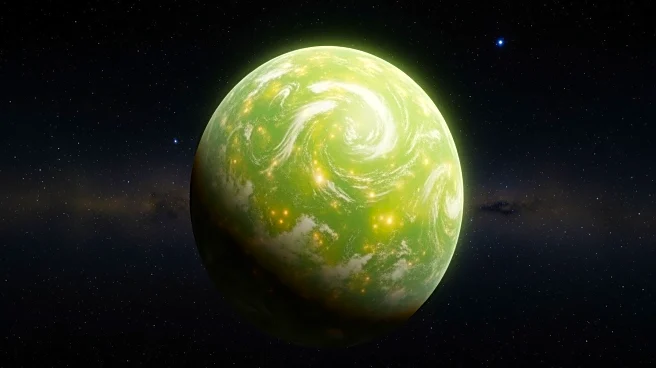
Astronomers have identified a unique exoplanet, PSR J2322-2650b, located 750 light-years from Earth. This planet, observed using NASA's James Webb Space Telescope, defies conventional planetary formation theories due to its unusual shape and atmospheric
composition. Unlike typical spherical planets, PSR J2322-2650b is stretched into a lemon-like shape due to the immense gravitational forces exerted by its host star, a pulsar. The planet's atmosphere is composed mainly of helium and pure carbon, with minimal oxygen or nitrogen, a composition never before observed. The planet orbits its pulsar at a remarkably close distance, completing an orbit in less than eight hours, which subjects it to extreme temperatures ranging from 1,200 to 3,700 degrees Fahrenheit.
Why It's Important?
The discovery of PSR J2322-2650b challenges existing theories about planetary formation and atmospheric composition. Its unique characteristics provide new insights into the effects of gravitational forces on planetary shapes and atmospheres. This finding could influence future research on exoplanets, particularly those orbiting pulsars, and may lead to a reevaluation of how scientists understand planetary systems. The unusual atmospheric composition also raises questions about the potential for similar planets elsewhere in the universe, expanding the scope of exoplanetary studies and possibly impacting the search for extraterrestrial life.