
What's Happening?
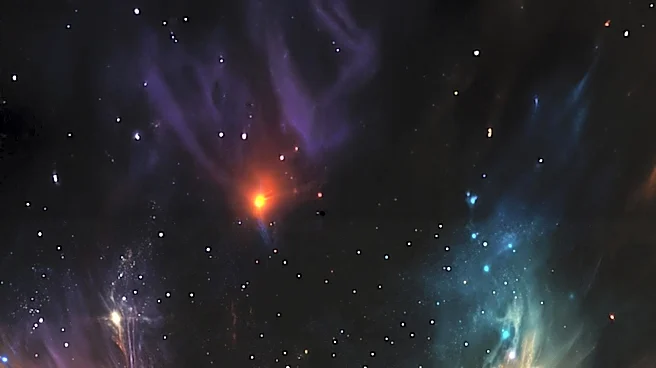
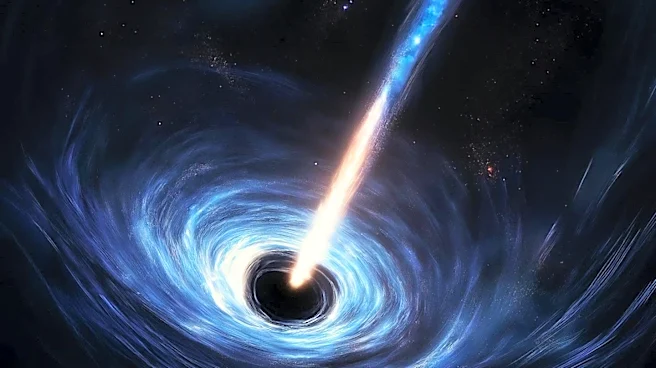
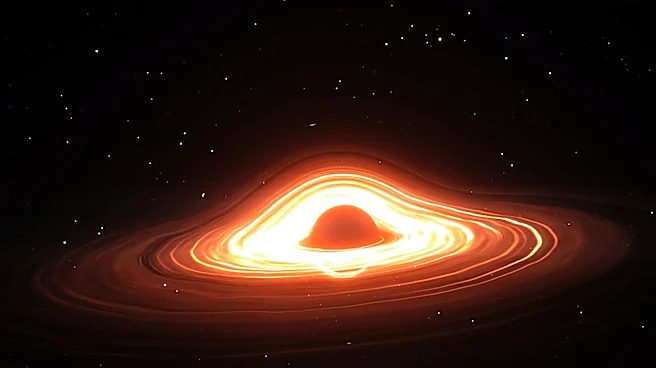
New observations from the James Webb Space Telescope (JWST) indicate that IRS 3, a mature star located near the Milky Way's supermassive black hole, Sagittarius A* (Sgr A*), is undergoing an exceptionally rapid phase of mass loss. This star is shedding
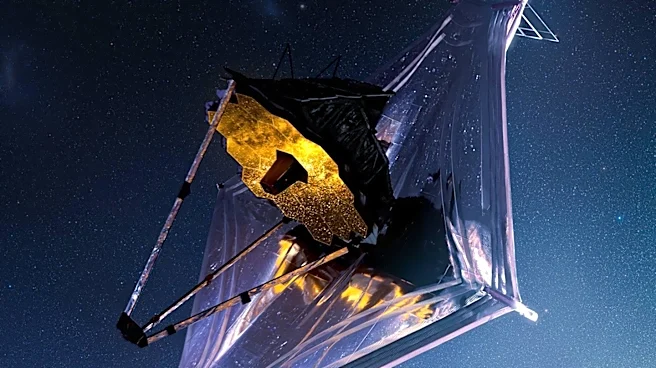
vast amounts of gas and dust into space, causing its surrounding envelope to continuously expand. Researchers, led by PD Dr. Florian Peißker of the University of Cologne’s Institute for Astrophysics, utilized JWST’s Mid-Infrared Instrument (MIRI) to study IRS 3, which is approximately 0.6 light-years from Sgr A*. The findings, published in the journal Astronomy & Astrophysics, suggest that IRS 3 is experiencing a 'superwind,' a period of extreme mass loss near the end of a massive star's life. The star is estimated to be losing material equivalent to Earth's mass every 18 days, contributing to the unusual size and density of its envelope. Surprisingly, water molecules were detected within this harsh environment, challenging previous assumptions about molecular survival so close to a black hole.
Why It's Important?
The discovery of a star rapidly losing mass and the presence of water molecules near the Milky Way's supermassive black hole has significant implications for astrophysics and our understanding of galactic environments. The 'superwind' phenomenon observed in IRS 3 provides crucial insights into the late stages of massive stars and their interaction with extreme gravitational forces. The detection of water in such a hostile region is particularly noteworthy, as it suggests that the environment around Sgr A* may be more conducive to the formation and persistence of complex molecules than previously thought. This challenges existing models of molecular chemistry in galactic centers and could influence theories about the distribution of elements, including those considered fundamental building blocks of life, throughout the universe. Understanding these processes helps refine our models of star evolution, black hole accretion, and the chemical enrichment of galaxies.
What's Next?
Researchers plan to conduct further investigations into IRS 3 and its surrounding environment. Professor Dr. Lucas Labadie’s group at the Institute for Astrophysics is developing a new generation of instruments for the Extremely Large Telescope in Chile’s Atacama Desert, specifically the METIS instrument, which is expected to begin operations in the coming years. This advanced instrumentation will allow astronomers to study the structure and composition of IRS 3’s vast envelope in greater detail. These future observations aim to provide a more comprehensive understanding of the 'superwind' phase, the mechanisms behind the rapid mass loss, and the survival of water molecules in the extreme conditions near Sgr A*. The ongoing research will continue to refine astrophysical models and contribute to our knowledge of the dynamic processes occurring at the heart of our galaxy.
Beyond the Headlines
The persistence of water molecules in the extreme environment near Sagittarius A* opens up intriguing possibilities regarding the potential for complex chemistry and even astrobiological implications in regions previously thought to be inhospitable. While not directly related to life, the presence of water, a key ingredient for life as we know it, in such a location suggests that the building blocks for life might be more widely distributed and resilient than once believed. This finding could prompt a re-evaluation of the conditions necessary for molecular complexity in the universe, extending beyond the traditional 'habitable zones' around stars. It also highlights the transformative power of advanced observational tools like the JWST, which are continually pushing the boundaries of our cosmic understanding and revealing unexpected phenomena that challenge long-held scientific assumptions.