




What's Happening?
A proposed executive order that would have significantly increased White House influence over grant awards at the National Institutes of Health (NIH) is reportedly 'looking dead.' This plan involved establishing a commission of political appointees, including
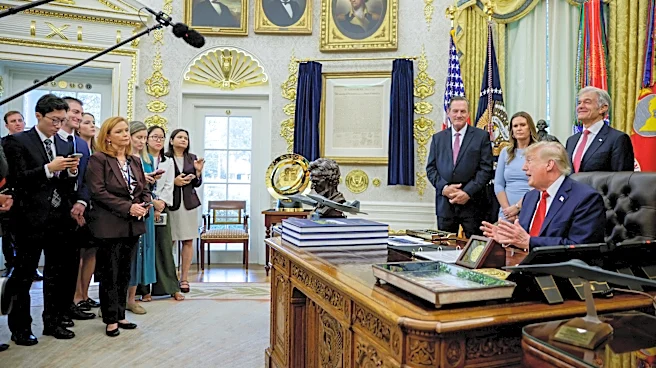
Office of Management and Budget (OMB) Director Russell Vought, with veto power over NIH grant decisions. The proposal faced strong bipartisan pushback from Congress. Senator Susan Collins (R-Maine), chair of the appropriations committee, sent a letter to Vought and NIH Director Jay Bhattacharya, urging them not to proceed with the plan, arguing it would undermine the federal government's objective of funding biomedical research based on scientific merit rather than political ideology. Other lawmakers also voiced their opposition. The idea for the executive order reportedly stemmed from an Oval Office meeting where Vought accused the NIH of funding projects inconsistent with the Trump administration's goals, with President Trump reportedly supporting the move to gain more political control over NIH grants, partly to target research funding for Harvard University.
Why It's Important?
This development is crucial for the independence and integrity of scientific research funding in the United States. The proposed executive order represented a significant threat to the long-standing principle of peer review and merit-based allocation of research grants at the NIH, which is a cornerstone of U.S. biomedical innovation. Political interference in grant decisions could lead to funding being diverted from critical scientific endeavors to projects aligned with political agendas, potentially hindering progress in public health and medical breakthroughs. The bipartisan opposition from Congress underscores the broad recognition of the importance of maintaining scientific autonomy. Had the executive order proceeded, it could have eroded trust in federal science agencies, discouraged top researchers, and ultimately weakened the nation's scientific leadership. The apparent shelving of the plan helps preserve the scientific community's ability to pursue research based on objective criteria, free from undue political influence.
What's Next?
With the proposed executive order reportedly 'looking dead,' the immediate next step is likely a continuation of the current system for NIH grant allocation, which prioritizes scientific merit and peer review. The bipartisan pushback from Congress suggests a strong legislative intent to safeguard the independence of federal science funding. However, the underlying tension between political oversight and scientific autonomy may persist. Future administrations or political figures could potentially revive similar attempts to exert control over research funding. The scientific community and congressional oversight bodies will likely remain vigilant against any future proposals that could compromise the integrity of the NIH's grant process. The incident also highlights the ongoing debate about the balance between executive branch authority and the independence of federal agencies, particularly those involved in critical scientific and public health missions.
Beyond the Headlines
The attempt to politicize NIH grant funding has deeper implications for the public's trust in science and the long-term health of the U.S. research enterprise. When funding decisions are perceived to be driven by political ideology rather than scientific merit, it can undermine the credibility of research outcomes and foster public skepticism towards scientific findings. This erosion of trust can have severe consequences, particularly in areas like public health, where evidence-based policy is paramount. Furthermore, the targeting of specific institutions, such as Harvard University, as reported, raises concerns about academic freedom and the potential for punitive actions against institutions perceived as politically unfavorable. Such actions could stifle innovation, discourage collaboration, and ultimately diminish the global standing of U.S. scientific research. The incident serves as a stark reminder of the constant need to defend the principles of scientific independence and meritocracy against political pressures.