
What's Happening?
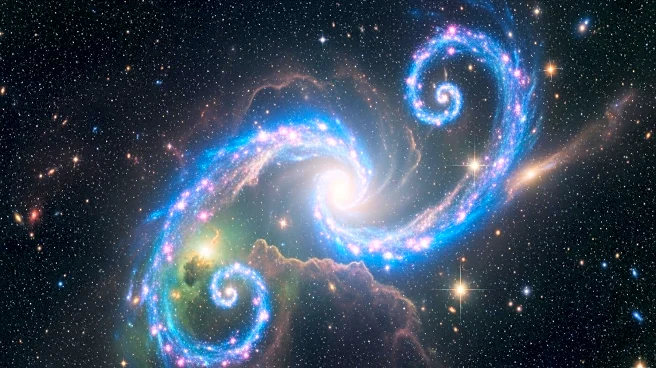
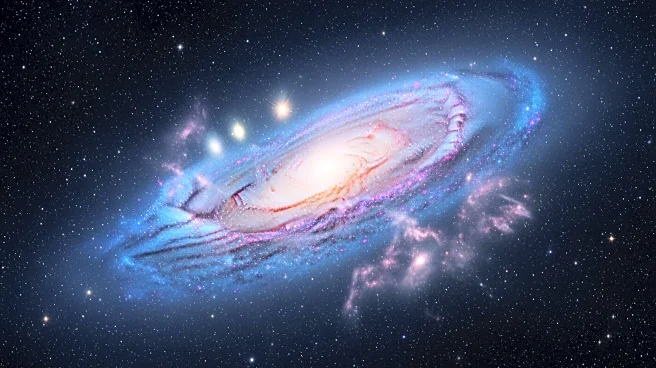
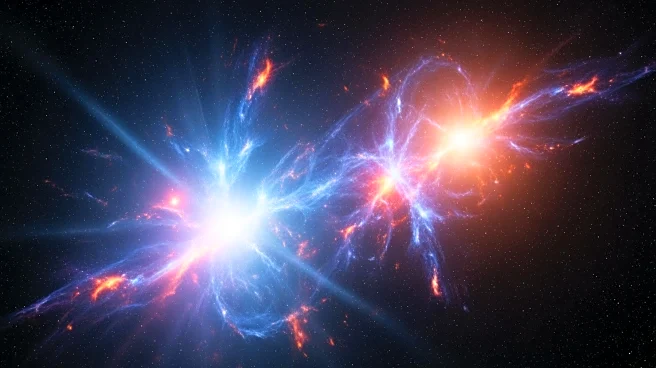
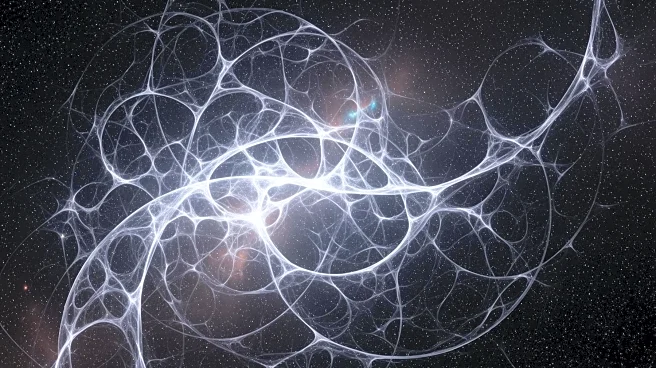
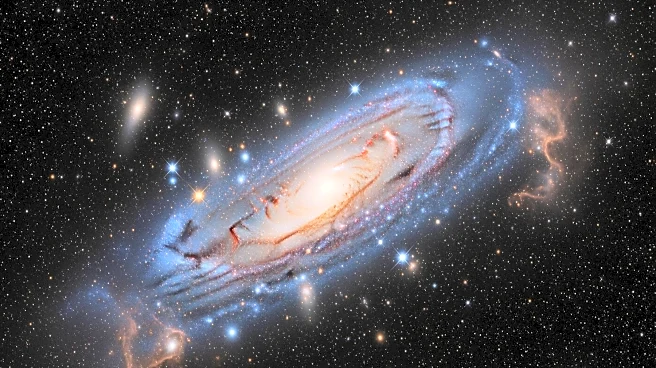
A recent claim circulating on social media suggested that scientists released an image showing a 'Cosmic Vine' of galaxies, discovered through the James Webb Space Telescope, as a line of galaxies connected in a helix structure. However, this claim has
been debunked. Researchers did indeed discover a cluster of galaxies, referred to as the 'Cosmic Vine,' but the image in question was not part of their official studies. The actual images released by the researchers show that the galaxies are not linked together in a helix-like shape and do not resemble human DNA. The 'Cosmic Vine' was first studied in 2024, described as a massive structure from the early universe consisting of 20 galaxies. Further studies in 2026 expanded this to 136 confirmed galaxies, but none of the images released depict them as a connected chain.
Why It's Important?
This incident highlights the challenges of misinformation in the digital age, particularly in the field of astronomy where complex scientific discoveries can be easily misrepresented. The spread of false images can lead to public misunderstanding of scientific phenomena and undermine the credibility of legitimate scientific research. It underscores the importance of critical evaluation of information shared on social media platforms. For the scientific community, maintaining the integrity of their findings is crucial, as misinformation can detract from genuine discoveries and the public's understanding of the universe.
What's Next?
The scientific community may need to increase efforts to communicate their findings more effectively to the public to prevent the spread of misinformation. This could involve more proactive engagement with media and social platforms to clarify and correct false claims. Additionally, platforms like Facebook and Instagram might consider implementing stricter verification processes for scientific content to prevent the dissemination of misleading information. Researchers will likely continue to study the 'Cosmic Vine' and other similar structures to further understand the early universe, potentially leading to new discoveries that can be shared with the public.
Beyond the Headlines
The incident also raises questions about the role of artificial intelligence and digital art in creating realistic but misleading representations of scientific phenomena. As AI-generated images become more sophisticated, distinguishing between genuine scientific imagery and artistic interpretations will become increasingly challenging. This could lead to ethical considerations regarding the use of AI in scientific communication and the responsibilities of creators in ensuring their work is not misused.