






What's Happening?
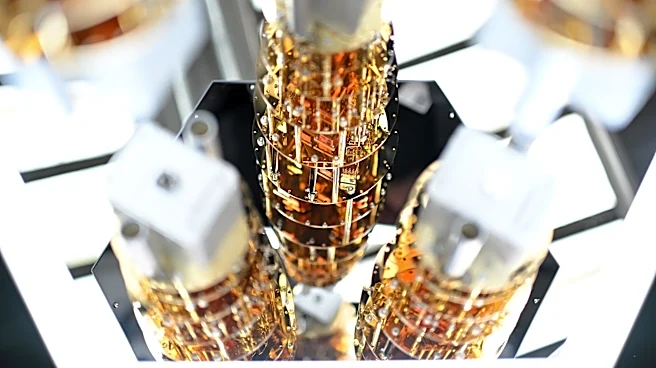
Moth Quantum has announced a new quantum computing record with its Tessa technique, successfully storing and retrieving 1,568 numerical values on IBM's 120-qubit Phoenix processor. This achievement addresses a significant hurdle in quantum computing:
efficiently getting ordinary information into quantum machines and retrieving it with high accuracy. The Tessa method utilizes neighboring qubits to manage information storage, allowing the processor's existing connections to handle operations without the need to move information between distant qubits. This approach avoids additional qubit-moving operations and helper qubits, with tested circuits reaching a depth of 19 two-qubit operations. Previous research in this area had only managed to recover 128 numerical values using 12 trapped-ion qubits, making Moth Quantum's result substantially larger.
Why It's Important?
This breakthrough by Moth Quantum is crucial for the advancement of quantum computing, particularly for applications like quantum machine learning. The ability to store and retrieve a larger volume of information more efficiently on quantum processors can unlock new possibilities for complex data processing. For U.S. industries, this could mean accelerated development in fields requiring high-performance computing, such as drug discovery, materials science, and financial modeling. Overcoming the bottleneck of data input and retrieval is a foundational step toward making quantum computers practical and scalable. While current recovery is imperfect, the technique demonstrates a path toward more robust quantum systems, potentially giving U.S. tech companies a competitive edge in the global quantum race.
What's Next?
Despite the record-setting achievement, information recovery remains imperfect, with the largest color image achieving a correlation of 0.69 with its source, compared to 0.95–0.96 for simpler images. The study notes that simulations did not include all interference between neighboring processor groups, and hardware experiments did not use error-correction techniques. Moth Quantum did not employ error mitigation, which could significantly reduce reconstruction errors in future hardware tests. Future work will likely focus on improving accuracy, potentially through advanced error correction and mitigation strategies. The study also highlighted that biological sequences, such as DNA and protein units, require high accuracy, and current recovery percentages do not yet establish dependable medical applications. Further research is needed to refine the Tessa technique for such sensitive applications.
Beyond the Headlines
The development of techniques like Tessa underscores the ongoing challenge and immense potential of quantum computing. While the immediate applications might be in specialized scientific and industrial domains, the long-term implications could be transformative. The imperfect recovery rates, particularly for complex data like biological sequences, highlight the inherent fragility and complexity of quantum systems. This also brings to light the ethical considerations of deploying quantum technologies in sensitive areas like medicine, where even a single error can have significant consequences. The pursuit of more robust and accurate quantum computing methods will not only push the boundaries of technology but also necessitate careful consideration of its societal impact and responsible development.