






What's Happening?
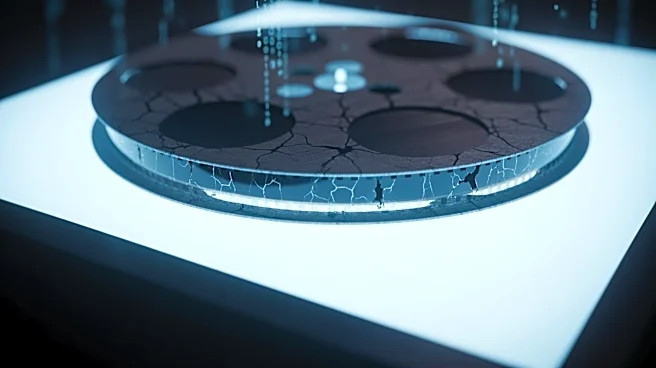
Recent advancements in deep learning are significantly improving the restoration of archival films suffering from structural damage such as scratches and patches. These damages, often caused by dust, dirt, mold, or color loss, are visually disruptive
and challenging to repair. Traditional methods like ranked order difference and variational methods have been used to detect and repair these damages, but they often struggle with motion scenes, leading to double-image phenomena. The study highlights the use of a hybrid-supervision pipeline and deep learning techniques, such as U-net and temporal convolutional networks, to enhance the detection and restoration processes. These methods leverage attention mechanisms and channel attention modules to improve the accuracy of detecting and repairing structural damage in films, addressing issues like temporal irrelevance and sparsity.
Why It's Important?
The restoration of archival films is crucial for preserving cultural heritage and historical records. The advancements in deep learning provide more effective tools for repairing films, ensuring that valuable historical content is not lost to time. This has significant implications for the film industry, museums, and educational institutions that rely on archival footage for research and exhibitions. By improving the accuracy and efficiency of film restoration, these technologies help maintain the integrity of historical records, allowing future generations to access and learn from them. Additionally, the development of these techniques can be applied to other fields requiring image restoration, such as medical imaging and cultural heritage preservation.