
What's Happening?
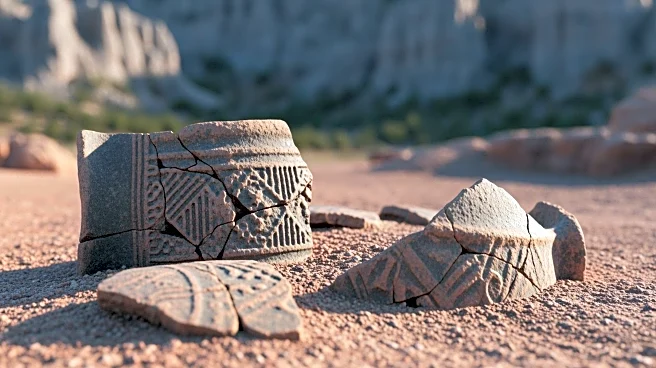
Archaeologists have uncovered pottery fragments near the alleged site of Noah's Ark on Mount Ararat in Turkey, potentially supporting theories of ancient human settlement in the area. The discovery was
made by Prof. Dr. Faruk Kaya of Agri Ibrahim Cecen University, who reported that the ceramic pieces were found close to the Durupinar Formation, a site long associated with the Biblical Ark. These fragments date back to the Chalcolithic period, between 5500 and 3000 BC, suggesting human activity during that era. The site has been a focal point for those seeking evidence of the Ark's existence, with recent radar scans by American researchers mapping possible remains beneath the surface. Dr. Kaya emphasized the importance of preserving the site, warning against the removal of stones and rocks that could damage this archaeological and heritage site.
Why It's Important?
The discovery of pottery fragments near the alleged Noah's Ark site is significant as it adds to the ongoing debate about the historical and archaeological validity of the Biblical narrative. If confirmed, these findings could provide tangible evidence of human activity in the region during a period that aligns with traditional estimates of the Ark's existence. This could have implications for both historical and religious scholarship, potentially attracting further research and tourism to the area. The preservation of the site is crucial, as it holds cultural and historical value that could be compromised by natural disasters or human interference.
What's Next?
The next steps involve further archaeological investigations to confirm the findings and explore the extent of human activity in the region. Researchers may conduct more detailed studies using advanced technologies like ground-penetrating radar to uncover additional artifacts or structures. There is also a call for protective measures to safeguard the site from natural and human-induced damage. The findings could prompt renewed interest from both the scientific community and the public, potentially leading to increased funding and resources for continued exploration.