


What's Happening?
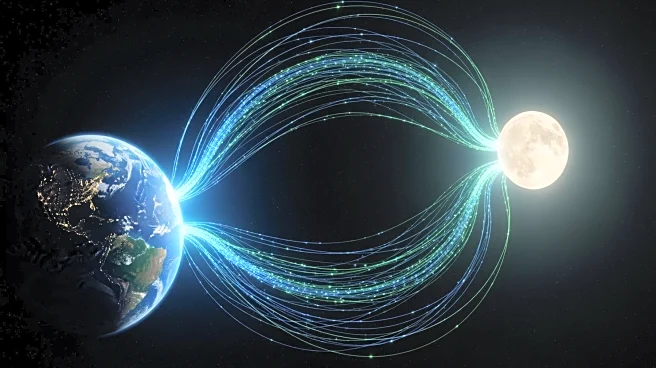
Recent research from the University of Rochester has uncovered that Earth's magnetic field has been instrumental in transporting atmospheric particles to the moon over billions of years. This discovery challenges previous assumptions that Earth's magnetic field would
block such transfers. Instead, the field appears to guide particles along its lines, allowing them to reach the moon. This process has likely contributed to the presence of volatile substances in the lunar soil, such as water and nitrogen, which were previously thought to be solely from the solar wind. The study utilized computer simulations to demonstrate that the current magnetic field and solar wind conditions are more effective in facilitating this transfer than earlier Earth conditions without a magnetic field.
Why It's Important?
The findings suggest that the moon's soil may hold a long-term archive of Earth's atmospheric history, offering insights into the planet's climate and biological evolution. This could be crucial for understanding Earth's past and predicting future changes. Additionally, the presence of volatiles like water and nitrogen on the moon could support future lunar exploration and habitation, reducing the need for resource transport from Earth. This has significant implications for space exploration strategies and the potential for sustainable human presence on the moon.
What's Next?
Future research may focus on analyzing lunar soil samples to further understand Earth's atmospheric history and the potential resources available on the moon. This could involve more detailed studies of the volatiles present in the lunar regolith and their origins. Additionally, the findings may influence the planning of future lunar missions, particularly those aimed at establishing a long-term human presence on the moon. The study also opens avenues for comparative research on other planets, like Mars, to understand atmospheric escape and planetary habitability.
Beyond the Headlines
The research highlights the interconnectedness of Earth and its celestial neighbor, the moon, through the magnetic field. It also raises questions about the role of magnetic fields in planetary evolution and habitability. Understanding these processes could provide insights into the conditions necessary for life on other planets and the potential for human colonization beyond Earth.