
What's Happening?
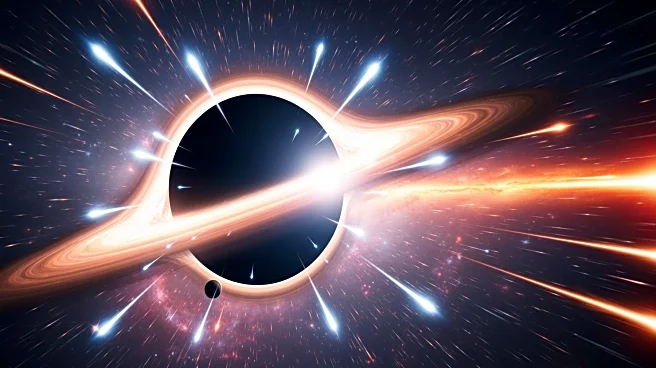
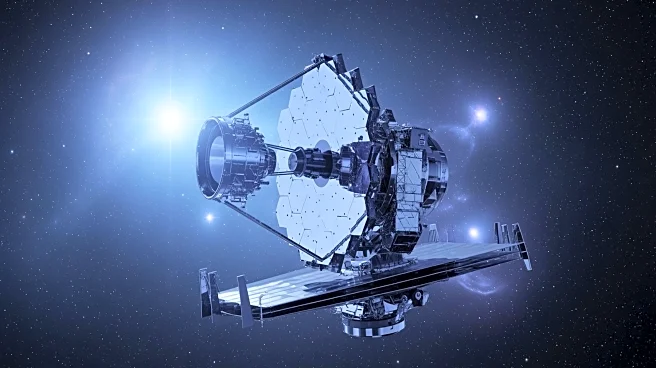
Researchers using the James Webb Space Telescope (JWST) have confirmed the existence of a supersonic runaway supermassive black hole, initially detected in 2023. This black hole, named RBH-1, is located 7.8 billion light-years away and is moving away from
its host galaxy at a speed of 3.43 million km/h. It has a mass of approximately 20 million solar masses and has left a trail of newborn stars spanning 200,000 light-years. The phenomenon is believed to have resulted from a complex interaction involving the merger of galaxies and subsequent ejection of the black hole.
Why It's Important?
The discovery of RBH-1 provides significant insights into the dynamics of galaxy mergers and the behavior of supermassive black holes. Understanding such phenomena is crucial for astrophysics, as it sheds light on the processes that shape galaxies and influence their evolution. The study of runaway black holes can also enhance our knowledge of gravitational interactions and the distribution of mass in the universe. This research highlights the capabilities of the JWST in advancing our understanding of cosmic events and structures.