







What's Happening?
In 2011, an excavator operator named Shawn Funk discovered a remarkably well-preserved dinosaur fossil at the Millennium Mine in Alberta, Canada. The fossil, identified as a nodosaur, is an armored herbivorous dinosaur dating back 110 million years. This
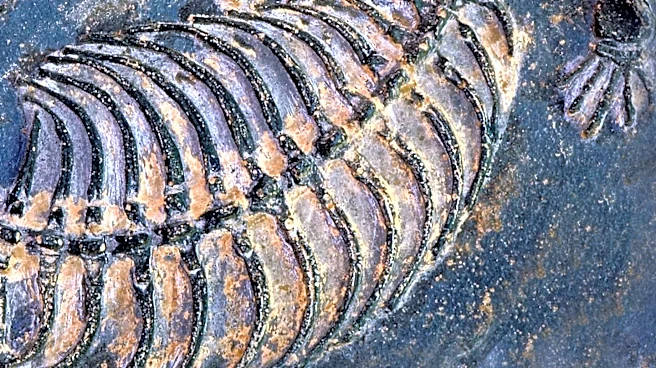
discovery is notable for its exceptional preservation, with the dinosaur's skin, scales, and armor intact, making it the most complete fossil of its kind ever found. The nodosaur, named Borealopelta markmitchelli, was unearthed during routine mining operations when Funk's equipment struck something unusually hard. The mining company, Suncor, promptly contacted the Royal Tyrrell Museum of Palaeontology, which dispatched a team to investigate. The fossil was encased in a 6,800-kilogram block of rock, which shattered during extraction, requiring extensive preparation work to reveal the dinosaur's features. The fossil's preservation is attributed to rapid burial in mud and minerals, which protected it from decomposition.
Why It's Important?
The discovery of the Borealopelta markmitchelli is significant for paleontology, providing a rare glimpse into the Cretaceous period's ecosystem. The fossil's state of preservation allows scientists to study the dinosaur's physical characteristics in unprecedented detail, offering insights into its behavior, diet, and environment. This find enhances understanding of the nodosaur's defensive adaptations, such as its spiny armor and camouflage coloring, which suggest it faced significant predation threats despite its size. The fossil also contributes to knowledge about the geographic distribution of dinosaurs, as Alberta's climate during the Cretaceous was vastly different from today, resembling a tropical environment. The discovery underscores the potential for significant paleontological finds in industrial sites, highlighting the importance of collaboration between industry and science.
What's Next?
The Borealopelta markmitchelli fossil is now a centerpiece at the Royal Tyrrell Museum, where it is part of an exhibition showcasing fossils found in Alberta's industrial sites. Ongoing research will likely focus on further analyzing the fossil's chemical composition to understand its coloration and other biological features. The discovery may prompt additional exploration in the region, as similar fossils could be uncovered in the oil sands. The collaboration between mining companies and paleontologists could serve as a model for future discoveries, ensuring that significant finds are preserved and studied. The fossil's public display will continue to educate and inspire interest in paleontology and the history of life on Earth.