



What's Happening?
Astronomy.com has released its 2026 Full Moon calendar, providing a comprehensive schedule of lunar phases and associated astronomical events. The calendar details the exact times for each Full Moon throughout the year, along with their traditional names,
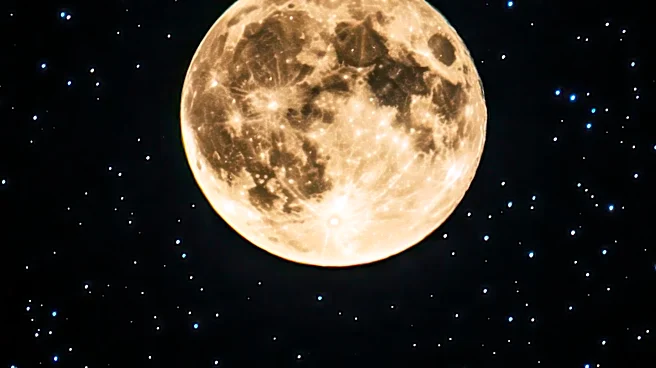
many of which are derived from Native American, Colonial American, or other North American traditions. For instance, the November Full Moon in 2026 will be the Beaver Moon, occurring on Tuesday, November 24, at 9:54 a.m. EST, and will also be a Super Moon. The article explains that a Full Moon occurs when Earth is positioned directly between the Sun and the Moon, causing the entire lunar face visible from Earth to be illuminated. It also outlines the various phases of the Moon, including New Moon, waxing crescent, First Quarter, waxing gibbous, Full Moon, waning gibbous, Last Quarter, and waning crescent, noting that a full cycle takes approximately 29.5 days.
Why It's Important?
This detailed lunar calendar is important for a variety of reasons, impacting both scientific observation and public engagement with astronomy. For amateur astronomers and sky-gazers, it provides crucial information for planning observations, especially for events like Super Moons or lunar eclipses. The inclusion of traditional names for each Full Moon also highlights the cultural and historical significance of lunar cycles, connecting modern observation with ancient practices that tracked seasonal changes and the passage of time. Understanding these cycles can also have practical implications, such as for agriculture, where the Harvest Moon historically aided farmers. Furthermore, the explanation of lunar phases and their gravitational effects on Earth's tides offers valuable educational content, enhancing public understanding of celestial mechanics and their influence on our planet.
What's Next?
Astronomy.com plans to update the article multiple times each week with the latest moonrise, moonset, and Full Moon schedules, along with other sky events. This ongoing update ensures that readers have access to the most current information for observing the night sky. The calendar also serves as a guide for upcoming significant events, such as the total lunar eclipse in March 2026 and the partial lunar eclipse in August 2026, allowing enthusiasts to anticipate and prepare for these occurrences. The continuous provision of such data supports ongoing public interest in astronomy and encourages engagement with celestial phenomena.
Beyond the Headlines
The detailed lunar calendar and explanations extend beyond simple scheduling, touching upon the broader human relationship with the cosmos. The traditional names for Full Moons, such as the Wolf Moon or Strawberry Moon, reflect a deep historical connection between human societies and natural cycles, illustrating how celestial events were once integral to daily life, agriculture, and cultural narratives. This cultural dimension underscores the enduring human fascination with the Moon and its phases. Moreover, the scientific explanations of phenomena like Super Moons and the Moon's influence on tides provide a foundation for understanding more complex astrophysical concepts, fostering scientific literacy and a greater appreciation for the intricate workings of our solar system.