
What's Happening?
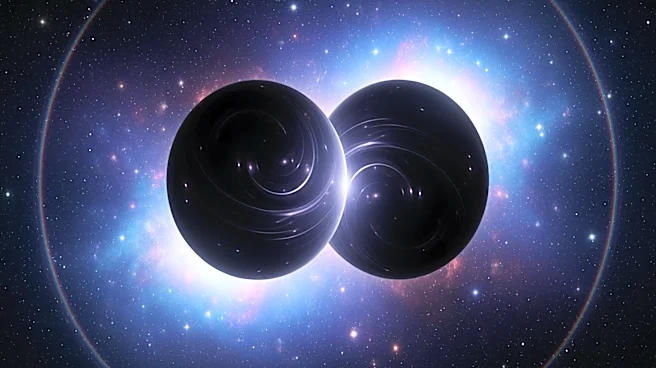
A group of physicists has proposed a new theory suggesting that black holes, which are traditionally known for their gravitational pull, may eventually evolve into white holes that repel matter. This theory refines
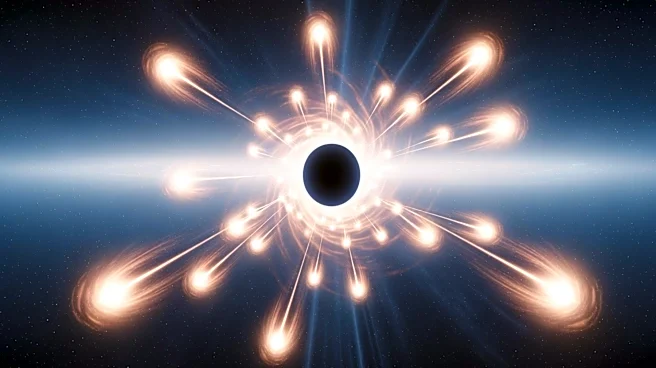
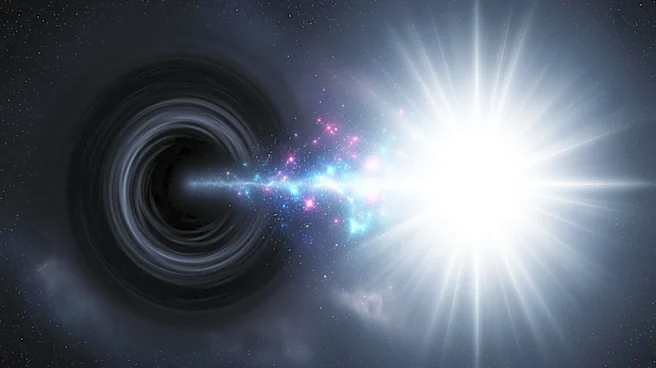
the understanding of black holes' lifespans, initially proposed by Stephen Hawking in 1974. Hawking's theory introduced the concept of Hawking radiation, where black holes lose mass over time as quantum particles escape their event horizon. The new research, published on arXiv, suggests that as black holes evaporate, they may enter a metastable state, transitioning from absorbing to repelling matter. This process involves three phases: initial radiation emission, a transitional phase, and a quantum entanglement phase, which requires a fully developed theory of quantum gravity to understand completely.
Why It's Important?
This new understanding of black holes could significantly impact the field of astrophysics and our comprehension of the universe's fundamental laws. If black holes can indeed transform into white holes, it challenges existing theories about the lifecycle of these cosmic entities and their role in the universe. This could also provide insights into the nature of dark matter, as primordial black holes are considered potential candidates for this mysterious substance. The research may influence future studies on quantum gravity and the information paradox, which questions whether information about matter is lost when a black hole evaporates. Such advancements could lead to breakthroughs in understanding the universe's formation and evolution.
What's Next?
Further research is needed to validate these findings and explore the implications of black holes transitioning into white holes. Scientists will likely focus on developing a comprehensive theory of quantum gravity to better understand the quantum entanglement phase of black hole evaporation. Observational studies may also be conducted to identify potential white holes or evidence of black holes in a metastable state. These efforts could involve collaborations between theoretical physicists and astronomers, utilizing advanced telescopes and space missions to gather data. The scientific community will be closely monitoring these developments, as they could redefine our understanding of cosmic phenomena.
Beyond the Headlines
The concept of black holes evolving into white holes raises intriguing philosophical and scientific questions about the nature of time and space. It challenges the traditional view of black holes as eternal entities and suggests a dynamic universe where cosmic structures can transform over time. This could lead to a reevaluation of the laws of physics and the potential for new discoveries about the universe's origins. Additionally, the study of black holes and their potential transformation into white holes may inspire new technological advancements in fields such as quantum computing and information theory, as scientists seek to understand and harness the principles underlying these cosmic phenomena.