




What's Happening?
Comedian Bill Maher is once again drawing sharp criticism for comments made on his HBO program, 'Real Time With Bill Maher,' where he connected the September 11, 2001, terrorist attacks directly to radical Islam. Conservative commentator Ben Shapiro highlighted
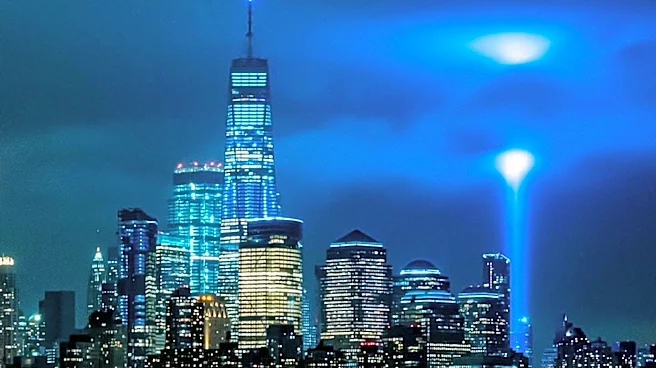
Maher's remarks, predicting a backlash similar to previous instances. Maher used the 25th anniversary of the attacks to criticize news organizations for their reluctance to use the term 'terrorism,' arguing that some journalism groups advise against it due to its 'emotionally and politically loaded' nature. He asserted that the 19 hijackers shared a worldview rooted in radical Islamism, not merely a generic political grievance, and described an ongoing conflict between radical Islamism and Western liberalism, citing opposition to religious freedom, homosexuality, and women’s equality. Maher also referenced polling indicating that a significant portion of young Americans hold a favorable view of Osama bin Laden.
Why It's Important?
Maher's comments reignite a long-standing debate in U.S. media and political discourse regarding the identification and characterization of the motivations behind terrorist acts. His criticism of news organizations for avoiding the term 'terrorism' touches on journalistic ethics and the perceived influence of political correctness on reporting. The discussion about radical Islamism and its clash with Western liberalism is a recurring theme in national security and foreign policy conversations, impacting public perception and policy approaches to counter-terrorism. The reference to polling data on Osama bin Laden's favorability among young Americans highlights potential generational shifts in understanding historical events and extremist ideologies, which could have implications for national unity and future security challenges. The controversy also underscores the ongoing tension between free speech and the potential for remarks to be seen as inflammatory or insensitive.
What's Next?
The immediate aftermath will likely see continued debate across media platforms, with commentators from various political spectrums weighing in on Maher's statements. Ben Shapiro's prediction of backlash suggests that Maher may face renewed calls for accountability or criticism from advocacy groups and public figures. News organizations and journalism ethics bodies might be prompted to re-evaluate their guidelines on terminology related to terrorism. Public discourse around the 9/11 attacks and the role of radical Islam will likely intensify, potentially leading to further discussions on historical interpretations and educational approaches. Maher, known for his controversial stances, is unlikely to retract his statements, which could further entrench the divide between those who agree with his analysis and those who find it problematic.
Beyond the Headlines
The controversy surrounding Maher's remarks delves into deeper societal issues concerning historical memory, the role of media in shaping public understanding, and the boundaries of political commentary. His assertion that public discussion has increasingly downplayed the religious affiliation of the 9/11 attackers points to a broader cultural struggle over how to discuss sensitive topics without alienating communities or appearing to generalize. This debate also touches on the concept of 'cancel culture' and the pressures public figures face when expressing views that are perceived as controversial. The ongoing discussion about radical Islamism versus Western liberalism reflects fundamental ideological differences that continue to influence geopolitical relations and domestic policy, highlighting the persistent challenge of reconciling diverse worldviews in a pluralistic society.