
What's Happening?
South Korea has committed to providing stronger support for Nepal's flood recovery efforts, including a pledge of USD 1 million in humanitarian assistance through the International Federation of Red Cross
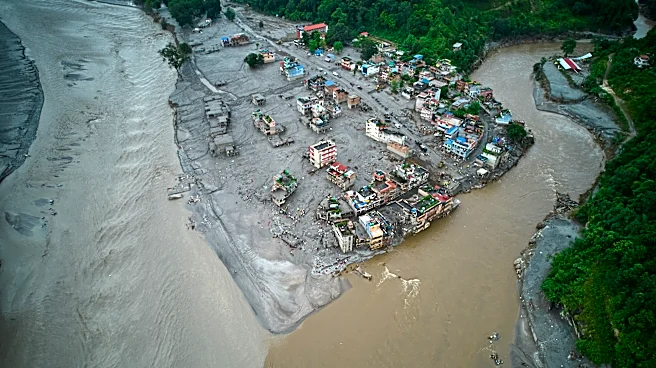
and Red Crescent Societies (IFRC). This commitment was made during talks in Kathmandu, where South Korean Foreign Minister Cho Hyun reaffirmed Seoul's dedication to Nepal's long-term rehabilitation following the August 26 Bhote Koshi flood. In addition to financial aid, South Korea will also supply approximately KRW 130 million in relief supplies. The discussions also focused on accelerating search operations for nine South Korean nationals who went missing after the flood at the Upper Trishuli-1 hydropower project in Rasuwa. The two nations further engaged in dialogue concerning climate-related loss and damage, trade, investment, technology, and labor cooperation.
Why It's Important?
This significant humanitarian aid from South Korea, channeled through the IFRC, underscores the critical role of international cooperation in disaster response and recovery. For the U.S., such international partnerships are vital for maintaining global stability and addressing humanitarian crises effectively. While the aid is directed towards Nepal, it highlights a broader trend of nations collaborating to mitigate the impacts of climate-related disasters, which can have far-reaching economic and social consequences. The IFRC's involvement ensures that the aid is distributed efficiently and effectively to those most in need, leveraging its extensive network and expertise in humanitarian action. The discussions on climate-related loss and damage also reflect a growing international recognition of the need for collective action to support vulnerable countries in adapting to and recovering from the effects of climate change, a concern that resonates with U.S. foreign policy and environmental initiatives.
What's Next?
Following South Korea's pledge, the USD 1 million in humanitarian assistance and KRW 130 million in relief supplies will be channeled through the IFRC to support flood-affected communities in Nepal. The IFRC will likely coordinate with local Red Cross and Red Crescent Societies to ensure the timely and effective distribution of aid, focusing on immediate relief and long-term rehabilitation efforts. Search operations for the missing South Korean nationals will continue to be a priority, with South Korea and Nepal collaborating closely. Further discussions between the two countries are expected to advance cooperation in areas such as trade, investment, technology, and labor, potentially leading to more comprehensive bilateral agreements. The ongoing dialogue on climate-related loss and damage may also influence future international policies and funding mechanisms for disaster-prone regions.
Beyond the Headlines
The South Korean aid package to Nepal, facilitated by the IFRC, highlights the interconnectedness of global humanitarian efforts and the increasing frequency of climate-induced disasters. Beyond the immediate relief, this collaboration fosters diplomatic ties and strengthens the capacity of international organizations to respond to complex emergencies. The focus on both immediate relief and long-term rehabilitation reflects a holistic approach to disaster management, aiming not just to alleviate suffering but also to build resilience against future shocks. The discussions on climate-related loss and damage also bring to light the ethical considerations surrounding climate justice, where developed nations are increasingly expected to support developing countries disproportionately affected by climate change. This aid, therefore, serves as a tangible example of international solidarity and shared responsibility in addressing global challenges.