
What's Happening?
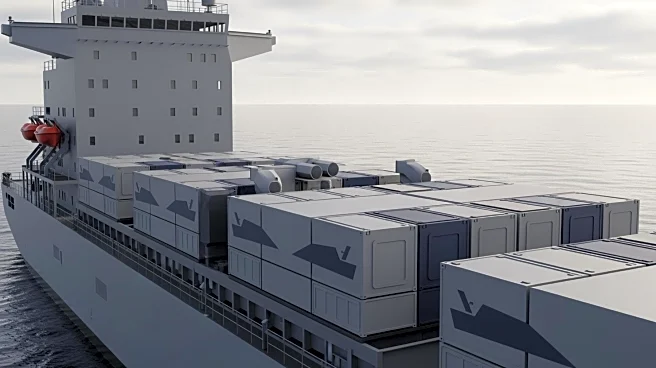
A recent development has emerged involving a Chinese cargo ship equipped with modular missile launchers, which has raised significant concerns regarding military strategy and naval capabilities. The ship,
described as a medium-sized cargo vessel, is outfitted with containerized vertical launchers, sensors, and self-defense systems, effectively transforming it into a heavily-armed surface combatant. This configuration includes a large rotating phased-array radar and a Type 1130 close-in-weapon system for defense against incoming threats. The ship's deck is covered with containerized vertical launchers, providing a substantial launch capacity. This development is part of China's broader strategy to leverage its commercial fleet for military purposes, potentially turning cargo ships into arsenal ships. The move is seen as a demonstration of China's advancing naval capabilities and its intent to achieve naval supremacy.
Why It's Important?
The emergence of China's cargo ship with modular missile launchers is significant for several reasons. It highlights China's innovative approach to expanding its naval capabilities by utilizing its vast commercial fleet for military purposes. This strategy could pose a substantial challenge to the U.S. Navy, which is already facing difficulties in keeping pace with China's shipbuilding advancements. The ability to convert commercial vessels into armed combatants could provide China with a strategic advantage, allowing for rapid deployment and increased naval presence. For the U.S. and its allies, this development underscores the need to reassess naval strategies and consider similar innovations to maintain a competitive edge. The potential for such ships to be used in various military applications raises concerns about maritime security and the balance of power in international waters.
What's Next?
The introduction of China's weaponized cargo ship concept is likely to prompt discussions and strategic evaluations within the U.S. Navy and its allies. There may be increased pressure to develop similar capabilities to counterbalance China's advancements. Additionally, this development could lead to heightened tensions in maritime regions where China seeks to assert its influence. The U.S. and its allies may need to explore new technologies and strategies to address the challenges posed by China's expanding naval capabilities. Furthermore, the international community may engage in discussions regarding the implications of converting commercial vessels for military use, considering the potential impact on maritime law and security.
Beyond the Headlines
The transformation of commercial vessels into military assets raises ethical and legal questions about the militarization of civilian infrastructure. This approach could blur the lines between civilian and military targets, complicating international maritime law and potentially increasing the risk of conflict. The concept of weaponized cargo ships also reflects a broader trend of utilizing unconventional methods to enhance military capabilities, which could influence future military strategies globally. As nations seek to adapt to these changes, there may be a shift in how naval power is projected and maintained, with implications for global security dynamics.