



What's Happening?
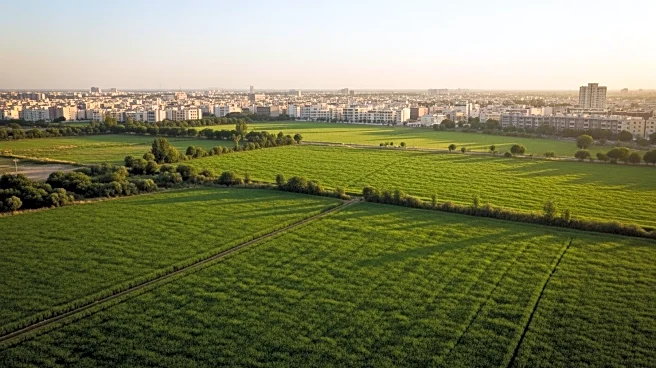
Recent research highlights the impact of peri-urban agriculture (PUA) on mitigating urban heat island (UHI) effects. The study, conducted in China, examined the dynamics of PUA and UHI from 2003 to 2018 using Leaf Area Index (LAI) and land surface temperature
data. It found that agricultural intensification in peri-urban areas can enhance greening trends, surpassing those of forests beyond 16 km from urban boundaries. The study suggests that marginalization of PUA near cities requires attention, as it affects crop productivity and cooling effects. The research employed transfer entropy analysis to explore the interactions between PUA and UHI, revealing that PUA can influence urban thermal environments through changes in temperature, precipitation, and radiation.
Why It's Important?
The findings underscore the potential of PUA as a strategy to combat UHI effects, which are exacerbated by urbanization. By enhancing vegetation cover in peri-urban areas, cities can reduce surface temperatures, improving urban livability and reducing energy consumption for cooling. This research is particularly relevant for urban planners and policymakers seeking sustainable solutions to urban heat challenges. The study also highlights the need for balanced agricultural management practices to maximize the cooling benefits of PUA while maintaining crop productivity.
What's Next?
The study's insights could inform urban planning and agricultural policies aimed at integrating PUA into urban development strategies. Future research may focus on optimizing PUA practices to enhance their cooling effects and exploring their applicability in different climatic regions. Policymakers may consider incentives for farmers to adopt intensive land use practices that contribute to UHI mitigation. Additionally, there may be opportunities for international collaboration to share best practices and technologies for sustainable urban agriculture.